WinGo Big Small vs Odd Even: How Number Groups Actually Work
Understand the difference between WinGo Big Small and Odd Even number groups, including why 0 is Small and Even, 5 is Big and Odd, and how results are classified.
In this article
- WinGo Big Small vs Odd Even: How Number Groups Actually Work
- What Does Big Small Mean in WinGo?
- Why Is Zero Considered Small?
- Why Is Five Considered Big?
- What Does Odd Even Mean in WinGo?
- Complete WinGo Big Small vs Odd Even Number Chart
- Big Small vs Odd Even: What Is the Difference?
- Four Possible Number Combinations
- How to Read a WinGo Result Using Both Groups
- Are Big Small and Odd Even Related to Colours?
- Do All WinGo Versions Use the Same Number Groups?
- Are Big and Small Outcomes Equally Likely?
- Why Past Big Small Results Cannot Predict the Next Number
- What If the WinGo Result Chart Appears Incorrect?
- WinGo Compared With K3 Lottery Number Groups
- Frequently Asked Questions
- Is 0 Big or Small in WinGo?
- Is 5 Big or Small?
- Is zero odd or even?
- Can a WinGo number be Big and Even?
- Does Big always mean Green?
- Are Odd and Even always selectable in WinGo?
- Can previous Big Small results predict the next result?
- Conclusion
WinGo Big Small vs Odd Even: How Number Groups Actually Work
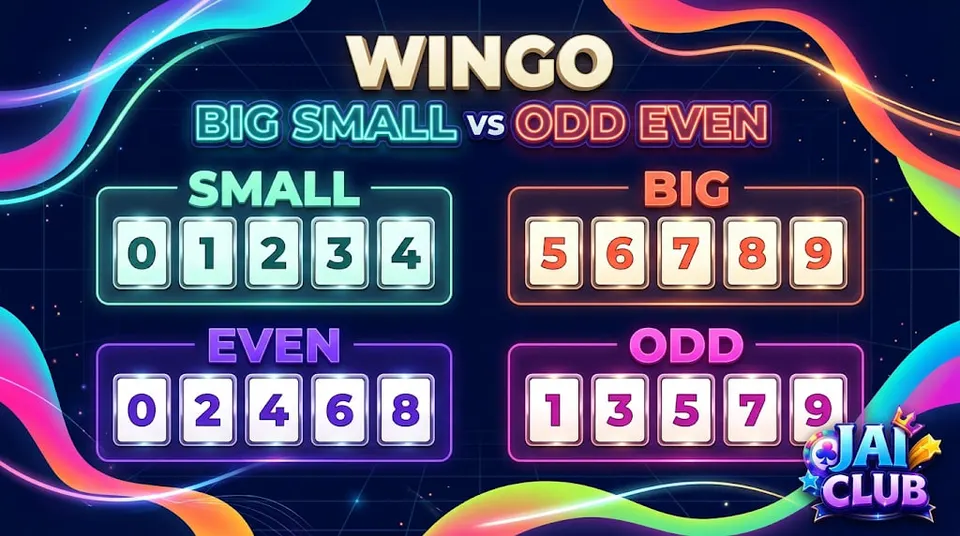
WinGo Big Small and Odd Even are two different ways of classifying numbers from 0 to 9. In a commonly used WinGo format, numbers 0–4 are Small, numbers 5–9 are Big, even numbers are 0, 2, 4, 6 and 8, and odd numbers are 1, 3, 5, 7 and 9.
This means a number can belong to both a size group and a parity group simultaneously. For example, 8 is Big and Even, while 3 is Small and Odd.
Understanding these classifications makes it easier to interpret numerical results without confusing Big/Small, Odd/Even and colour-related information.
What Does Big Small Mean in WinGo?
Big Small is a numerical classification used in many WinGo-style games. The ten possible digits are divided into two groups.
Small numbers: 0, 1, 2, 3, 4
Big numbers: 5, 6, 7, 8, 9
The dividing point is between 4 and 5.
The terms Big and Small describe the value of a number, not whether a result is favourable or unfavourable.
For example:
- If a completed round shows 2, its size category is Small.
- If a completed round shows 4, its size category is Small.
- If a completed round shows 5, its size category is Big.
- If a completed round shows 9, its size category is Big.
The classification is fixed in this commonly described format. However, the rules of the specific game version should always be checked before assuming how selections or settlements are handled.
Why Is Zero Considered Small?
Zero is the lowest digit in the 0–9 number range.
When the Small group contains digits from 0 through 4, zero naturally belongs to Small.
Some readers mistakenly assume zero belongs to neither category because it represents an absence of quantity. In this classification, zero is still a valid numerical result.
Its position in the Small group has nothing to do with its colour classification or any special symbol that may appear alongside it.
Why Is Five Considered Big?
The ten digits are divided into two equally sized groups.
Since Small includes 0, 1, 2, 3 and 4, Big begins at 5.
Therefore, 5 is Big even though it is positioned near the middle of the overall number range.
The boundary is important because people sometimes assume that 5 should be neutral or belong to Small. Neither assumption matches the common 0–4 and 5–9 format.
What Does Odd Even Mean in WinGo?
Odd and Even describe a different mathematical property.
An even number can be divided by 2 without leaving a remainder. An odd number leaves a remainder of 1 when divided by 2.
In the 0–9 range:
Even: 0, 2, 4, 6, 8
Odd: 1, 3, 5, 7, 9
Zero is an even number in standard mathematics, while five is odd.
Odd/Even classification may be useful when analysing a result chart, even if a particular game interface does not provide Odd and Even as separate selectable options.
It is important not to assume that every WinGo implementation offers the same selection types.
Complete WinGo Big Small vs Odd Even Number Chart
The following table combines both numerical classifications.
| Number | Big or Small | Odd or Even |
|---|---|---|
| 0 | Small | Even |
| 1 | Small | Odd |
| 2 | Small | Even |
| 3 | Small | Odd |
| 4 | Small | Even |
| 5 | Big | Odd |
| 6 | Big | Even |
| 7 | Big | Odd |
| 8 | Big | Even |
| 9 | Big | Odd |
This chart provides a straightforward way to understand the categories without relying on an application's visual indicators.
For instance, number 6 is not simply Big. It is also Even.
Likewise, number 1 is both Small and Odd.
These descriptions are not contradictory because the two groups measure different properties.
Big Small vs Odd Even: What Is the Difference?
Although both systems classify the same ten digits, they answer different questions.
| Feature | Big Small | Odd Even |
|---|---|---|
| Classification | Numerical size | Divisibility by 2 |
| First group | Small: 0–4 | Even: 0, 2, 4, 6, 8 |
| Second group | Big: 5–9 | Odd: 1, 3, 5, 7, 9 |
| Boundary | Between 4 and 5 | Alternates across digits |
| Example for 8 | Big | Even |
| Example for 3 | Small | Odd |
The easiest way to remember the difference is that Big/Small depends on where a number sits within the range, while Odd/Even depends on whether the number is divisible by two.
A number can therefore be Big and Odd, Big and Even, Small and Odd, or Small and Even.
Four Possible Number Combinations
The 0–9 range can be divided into four combinations.
Small and Even: 0, 2, 4
Small and Odd: 1, 3
Big and Even: 6, 8
Big and Odd: 5, 7, 9
Notice that these combined groups do not contain equal numbers of digits.
Some combinations contain three digits while others contain two.
This distinction matters when interpreting mathematical classifications. Two separately balanced categories do not automatically produce four equally sized combined categories.
How to Read a WinGo Result Using Both Groups
Imagine a result history containing the following completed numbers.
These examples are illustrative, not live results from a gaming platform.
| Example Round | Result | Size | Parity |
|---|---|---|---|
| A | 7 | Big | Odd |
| B | 2 | Small | Even |
| C | 0 | Small | Even |
| D | 5 | Big | Odd |
| E | 8 | Big | Even |
| F | 3 | Small | Odd |
To interpret any row, first identify the numerical result.
Next, determine whether it falls between 0–4 or 5–9.
Finally, check whether the number is odd or even.
For example, in Round E, the number is 8. It belongs to Big because it is greater than 4, and it belongs to Even because it is divisible by 2.
The completed result is the factual information displayed by the history table. Its classification should not be mistaken for a forecast about the next round.
Are Big Small and Odd Even Related to Colours?
Some WinGo formats also associate each digit with a colour such as Red, Green or Violet.
However, colour classification and numerical size are not the same system.
For instance, a number may belong to Big while also having a Green colour association. Similarly, a Small number may be associated with Red.
Special cases involving 0 and 5 can also affect how Violet is represented.
To understand those exceptions, read our detailed article on why 0 and 5 are different in colour trading.
That guide separates ordinary Red/Green number associations from special Violet-related outcomes.
The important point is that size, parity and colour should be interpreted as separate classifications unless the actual game rules explicitly connect them.
Do All WinGo Versions Use the Same Number Groups?
The 0–4 Small and 5–9 Big format is commonly described in WinGo guides. Nevertheless, different gaming services can use different interfaces, labels and rule descriptions.
One version might prominently display Big/Small, while another emphasises colours and results.
Some interfaces show additional numerical statistics or charts without offering every displayed category as a selectable game option.
Before relying on any classification, check:
- The number range supported by the game.
- The definitions of Big and Small.
- Whether Odd and Even appear as game selections or simply mathematical descriptions.
- The treatment of 0 and 5.
- Any special rules published for the chosen round format.
Avoid treating a guide for one version as universal documentation for every platform using the WinGo name.
Are Big and Small Outcomes Equally Likely?
If each of the ten digits from 0 to 9 is independently generated with equal probability, there are five numbers in each size group.
Under that simplified mathematical model:
- Small has 5 out of 10 possible digits.
- Big has 5 out of 10 possible digits.
- Odd has 5 out of 10 possible digits.
- Even has 5 out of 10 possible digits.
Each individual classification would therefore cover half of the possible outcomes.
However, this mathematical example is not evidence that a particular gaming platform generates its outcomes uniformly or independently.
Actual probability, game rules and settlement conditions must be established separately.
It is also incorrect to assume that a particular group becomes more likely simply because several previous rounds belonged to the opposite group.
Why Past Big Small Results Cannot Predict the Next Number
A common misunderstanding occurs when readers examine a history chart and notice repeated categories.
For example, a sequence may show Big, Big, Big, Small and Big.
Someone might conclude that Small must appear next to balance the chart.
That conclusion is not supported by the sequence alone.
Historical information tells us what has already occurred. It does not establish that future results must compensate for earlier outcomes.
Even when analysing a fair, independent random process, previous outcomes do not force the next result to belong to a particular group.
If an actual game uses a different mechanism, that mechanism would need to be examined independently rather than inferred from a short result chart.
No grouping system guarantees a future result.
What If the WinGo Result Chart Appears Incorrect?
Sometimes a user may understand the number classification correctly but encounter a confusing result display.
For example, a history table may still show an older period, while the countdown has already finished.
That is a separate technical question from whether a number is Big, Small, Odd or Even.
Our article on why WinGo result history sometimes updates late explains common reasons for delayed updates, including connectivity, browser caching and interface synchronisation.
If results appear inconsistent, compare the displayed period identifier and completed number before drawing conclusions.
Avoid assuming that a delayed display changes the mathematical classification of a result.
WinGo Compared With K3 Lottery Number Groups
WinGo is not the only game format that uses numerical classifications.
K3-style lottery games commonly use three dice, creating a combined total between 3 and 18.
Unlike a single-digit WinGo result, a three-dice total can be produced through several different combinations.
For example, different dice arrangements can lead to the same total.
This creates a different mathematical distribution from a simplified single-digit model.
Our guide to K3 dice sums and the frequency of different totals explains why middle totals have more possible combinations than extreme totals.
Comparing these formats helps demonstrate why numerical rules from one game should not automatically be applied to another.
Frequently Asked Questions
Is 0 Big or Small in WinGo?
In the commonly used 0–9 classification, zero belongs to Small because the Small group contains 0, 1, 2, 3 and 4.
Is 5 Big or Small?
Five belongs to Big. The Big group contains digits 5 through 9.
Is zero odd or even?
Zero is even in standard mathematics because it is divisible by 2 without a remainder.
Can a WinGo number be Big and Even?
Yes. Numbers 6 and 8 are both Big and Even under the standard mathematical classifications.
Does Big always mean Green?
No. Big/Small and colour classification describe different properties. A Big number does not automatically correspond to a particular colour.
Are Odd and Even always selectable in WinGo?
Not necessarily. Odd/Even is a mathematical way to classify digits, but the selectable options depend on the specific game interface.
Can previous Big Small results predict the next result?
No reliable prediction follows from historical classifications alone. Repeated results do not guarantee that the next round will change category.
Conclusion
The difference between WinGo Big Small and Odd Even is straightforward once the number groups are separated.
Big Small divides the digits at 5, while Odd Even divides them according to their mathematical parity.
Zero is Small and Even. Five is Big and Odd. Every result from 0 to 9 belongs to one category from each system.
For a broader explanation of WinGo, K3, 5D, slots and other related formats, visit the Jai Club Game guide.
Understanding these classifications is useful for reading results accurately, but no classification guarantees or predicts the outcome of a future round.