Why Two Jai Club Game Links May Show Different Interfaces
Why do two Jai Club game links sometimes open different websites or app layouts? Explore domain differences, browser caching, redirects, software versions and how to identify suspicious or unrelated services.
In this article
- Why Do Two Jai Club Game Links Look Different?
- Why the Same Gaming Name Can Appear on Different Websites
- Website Design Does Not Establish Ownership
- Different Website Versions Can Explain Layout Changes
- Chrome and Android Applications May Display Different Interfaces
- Mobile and Desktop Versions Can Look Surprisingly Different
- Browser Cache Can Make an Interface Look Outdated
- Why Domain Names Are More Important Than Logos
- Why Website Redirects Can Create Confusion
- Different Game Catalogues Do Not Always Mean Different Providers
- Can Two Different Websites Display the Same Results?
- Why Different APK Files Require Extra Attention
- Why Payment Information Deserves More Attention Than Layout
- Can Google Search Results Identify the Official Website?
- How to Distinguish a Technical Difference From an Identity Problem
- Frequently Asked Questions
- Why do two Jai Club Game websites have different designs?
- Does the same Jai Club logo prove two websites are connected?
- Can Chrome and Android app interfaces look different?
- Is a website redirect proof of official ownership?
- Does HTTPS mean a Jai Club website is genuine?
- Can different websites display the same WinGo results?
- Are all Jai Club APK files identical?
- Does appearing in Google mean a website is official?
- Conclusion
Why Do Two Jai Club Game Links Look Different?
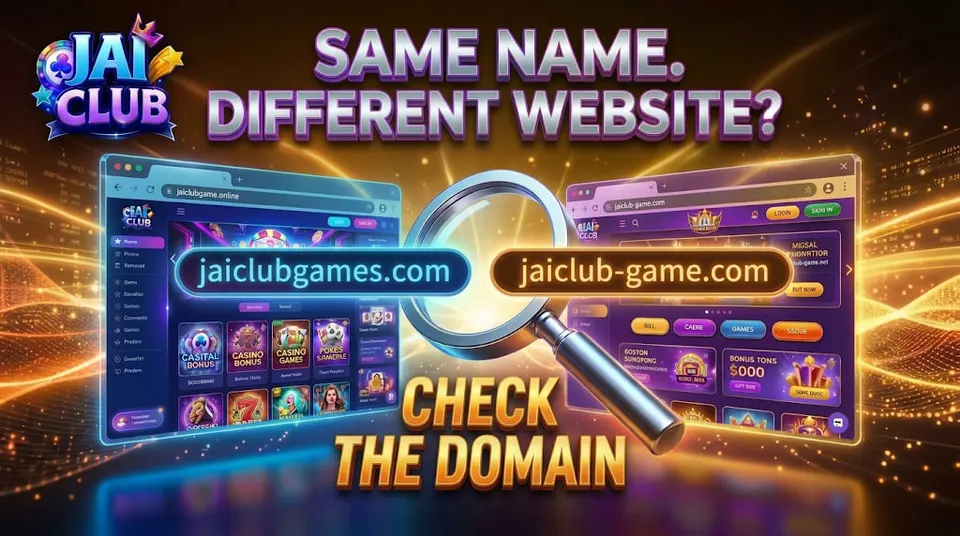
Imagine searching for Jai Club Game and opening two websites that appear to offer similar information. Both display familiar gaming terminology, colourful interfaces and references to WinGo, K3, 5D or other popular games. However, the moment the pages finish loading, the differences become noticeable.
One website may display a modern gaming dashboard with prominent category buttons, while another uses a more traditional layout with separate sections for results, applications and account information. The colours may differ, the navigation may be arranged differently, and even the available information may not match.
This raises an important question. Why can two Jai Club Game links display completely different interfaces even when they appear to refer to the same gaming platform?
The answer is not always straightforward. Some differences result from ordinary website updates, mobile optimisation or software changes. Others occur because the websites are operated independently, serve different purposes or are attempting to imitate a familiar brand.
Understanding these possibilities is important because visual similarity does not automatically establish that two websites belong to the same provider.
Why the Same Gaming Name Can Appear on Different Websites
A gaming name can appear across several types of websites without every website being operated by the same organisation.
For example, an informational website may publish guides about WinGo rules, slot symbols, result histories and gaming terminology. Another website may provide access to an actual gaming service. A third may specialise in application information, while a separate promotional page may discuss offers associated with the gaming name.
All these websites may reference Jai Club Game, but their functions can be completely different.
An informational guide does not necessarily operate the game it discusses. Similarly, a website containing an application download button is not automatically connected to the original software publisher.
This is particularly important for users who discover websites through Google Search. Search results can contain educational articles, third-party reviews, promotional material and service pages together.
The name displayed in a search result does not independently establish the website's ownership or purpose.
Website Design Does Not Establish Ownership
One of the most common misunderstandings is assuming that two websites belong to the same operator because they use similar visual elements.
Gaming interfaces often share familiar design conventions. Bright buttons, colourful category cards, numerical result displays and account navigation are widely used across different platforms.
Even the same or similar logos can appear on unrelated websites.
A copied logo is relatively easy to reproduce. Colours and layouts can also be imitated, especially when a website uses common design components.
This means visual resemblance is not strong enough to establish ownership.
The more important questions concern the actual domain, the organisation operating the website, the software publisher and whether any claimed connection can be independently verified.
A professional-looking design may create a favourable impression, but it should not replace basic identity checks.
Different Website Versions Can Explain Layout Changes
Not every difference between two pages indicates a problem. Websites regularly undergo redesigns and software updates.
An older version may display all navigation options across the top of the screen, while a newer release introduces a compact menu or larger game cards. The homepage may also change as new information is introduced or existing sections are reorganised.
A service might replace outdated graphics, update its colour scheme or reorganise its categories without changing its underlying purpose.
As a result, screenshots captured at different times can show substantially different interfaces.
However, a claimed software update does not automatically establish that two websites are genuinely connected. The relationship should still be supported by reliable provider information.
A redesign explains why a verified service may look different over time. It does not prove that every unfamiliar website using the same name is part of that redesign.
Chrome and Android Applications May Display Different Interfaces
Another explanation involves the technology used to access the service.
A website opened through Google Chrome may use responsive web design, meaning that its interface adjusts according to the browser and screen dimensions.
An installed Android application may use a different navigation system, layout and method of presenting content. Some applications display web-based content inside an app environment, while others use dedicated Android components.
Consequently, the same or closely related service may look different depending on whether it is opened through a browser or an installed application.
For example, Chrome may display an address bar and standard browser controls. An Android app might instead present a dedicated navigation bar and a different arrangement of category icons.
These differences can be normal, but they should not be used to assume that an unknown APK belongs to a verified provider.
Our article on Jai Club Games on Chrome vs Android App explains how installation methods, permissions, browser storage and application updates differ.
The important distinction is between a legitimate difference in presentation and an entirely separate service using similar branding.
Mobile and Desktop Versions Can Look Surprisingly Different
Responsive design can create major visual differences even within one website.
On a desktop screen, the navigation may appear horizontally with several categories visible at once. The homepage might feature a large banner followed by multiple columns of content.
On a mobile phone, the same website may rearrange those elements into a single column. Navigation options may move into a collapsible menu, banners may use alternative image sizes, and category cards may appear in a scrolling layout.
These changes are intended to make a website easier to use across different screen sizes.
However, some websites have separate mobile interfaces or older designs that have not been updated consistently.
Therefore, comparing a desktop screenshot with a mobile screenshot does not necessarily reveal whether the pages belong to different services.
A more reliable comparison uses the exact destination address and identifiable provider details rather than layout alone.
Browser Cache Can Make an Interface Look Outdated
Browsers often store website resources locally to improve loading performance. This process is known as caching.
A cached file might contain an older image, stylesheet or interface component. If the website has recently been updated, the browser may temporarily display a combination of newer content and previously stored resources.
For example, a homepage might load its updated text while still displaying an older navigation style or banner.
This can make two browser sessions appear different.
A normal refresh may retrieve updated resources, although the result depends on the website's caching configuration.
Nevertheless, caching should not automatically be blamed for every difference. If two pages have different domains, different account systems or unrelated payment instructions, these differences require separate investigation.
Caching can explain outdated presentation. It does not establish that two independently hosted services are legitimate versions of one another.
Why Domain Names Are More Important Than Logos
A domain name is a key part of a website's identity.
Two websites can use the same branding while operating under completely different domains. The difference may be legitimate, but it should not be ignored.
For example, an operator might maintain a main website and an independently documented support domain. Another organisation might publish an informational website about the same product without any operational connection.
A similar-looking domain can also be used to imitate a familiar service.
The important point is that a domain must be evaluated in context. A shared keyword, similar spelling or matching logo does not establish the relationship between two addresses.
The final destination of a link is particularly important when sensitive information is involved.
Users should be careful about entering passwords, OTPs or payment details on unfamiliar websites simply because those websites use a recognisable gaming name.
Why Website Redirects Can Create Confusion
A redirect sends the browser from one web address to another.
Redirects are widely used for legitimate purposes. A website may move to a new address, consolidate old pages or send visitors to an updated section.
However, redirects can also make it difficult to understand which website a person is actually accessing.
A visitor might click a link labelled Jai Club Game and arrive on a completely different domain. The destination could be related to the original page, but the redirect itself does not prove that relationship.
This distinction becomes especially important when a link leads to an account page, application download or payment instruction.
A website can redirect visitors to another destination without being operated by the same organisation.
Therefore, the final destination should be checked independently rather than assuming that the original link provides a guarantee of authenticity.
Different Game Catalogues Do Not Always Mean Different Providers
Game availability can vary according to provider arrangements, website configuration, account access and software versions.
One interface might prominently display WinGo and K3, while another places greater emphasis on slot games or crash titles.
A website may also reorganise its game categories without changing the underlying service.
However, similar game catalogues can be found on unrelated platforms.
Aviator, Chicken Road and many slot titles are recognised across the wider online gaming market. Their presence on two websites does not necessarily establish common ownership.
The same principle applies to numerical games. WinGo, K3 and 5D are game formats rather than unique proof of a particular website's identity.
A catalogue can help describe what a website offers, but it cannot by itself verify the operator.
For readers interested in these differences, the Jai Club Games overview explains the main game categories and their general mechanics.
Can Two Different Websites Display the Same Results?
Two websites may display similar or identical game results for several reasons.
They might genuinely obtain information from the same underlying provider. One website might reproduce publicly available results, or both could use a shared data source.
However, identical visible results do not establish that two websites use the same account system.
For example, a WinGo period identifier and completed number can be displayed independently from a private wallet transaction record.
Two websites could show the same numerical result while having entirely separate account systems and financial arrangements.
This is why public result information and account-specific records should not be treated as interchangeable evidence.
A matching result may support further investigation into the source of the data, but it does not independently establish the legitimacy of either website.
Why Different APK Files Require Extra Attention
Android application packages introduce additional questions beyond website design.
Two pages may offer files with similar names, identical icons and comparable version numbers. However, the underlying software can still differ.
One file might be an authentic release, another might be outdated, and a third could contain modifications from an unrelated distributor.
A filename does not prove that the application was published by the claimed organisation.
The same applies to an application icon or promotional screenshot.
Publisher identity, package information and the distribution source are more relevant than visual familiarity.
Users should avoid installing unknown APK files based solely on recommendations from messaging groups or websites claiming to provide the newest version.
Device security warnings should also be taken seriously rather than disabled to complete an unfamiliar installation.
Why Payment Information Deserves More Attention Than Layout
A difference in website colour or menu arrangement is primarily a presentation issue.
A difference in payment details can have more serious consequences.
Imagine two websites using similar gaming branding but presenting different recipient information for financial transactions.
The difference might have a legitimate explanation, but that explanation should be independently verified before any payment is authorised.
A familiar logo does not prove that a payment recipient belongs to the intended service.
Likewise, a messaging account claiming to be customer support is not reliable evidence of ownership merely because it uses official-looking branding.
Unexpected requests for additional payments, verification codes or confidential account information deserve particular caution.
When financial instructions differ, the identity of the recipient matters more than the visual appearance of the page.
Can Google Search Results Identify the Official Website?
Search engines help people discover relevant pages, but a search ranking is not an ownership certificate.
A website may rank for Jai Club Game because it contains useful informational content about that topic.
Another page may rank because it discusses an application, game mechanics or related search questions.
Ranking does not automatically establish that Google has verified the website as the service operator.
This distinction matters because educational guides and service websites can appear within the same search results.
A well-written article about a platform should not be confused with an official account service.
Users should evaluate the page's stated purpose and independently verifiable provider information.
How to Distinguish a Technical Difference From an Identity Problem
The most useful approach is to consider the type of difference being observed.
A changed menu, updated banner or mobile-specific layout can be an ordinary design variation.
A different domain, unrelated publisher, unknown APK source or unexpected payment destination raises a different category of question.
These changes concern the identity and trustworthiness of the service rather than its appearance.
A cautious reader should therefore look beyond design and consider whether the website clearly explains what it provides.
An informational website should be identifiable as an informational resource. A service requesting personal or financial information should have a verifiable identity.
Our article on what a Jai Club Game screenshot can actually prove discusses why visual evidence should not be mistaken for proof of authenticity.
Frequently Asked Questions
Why do two Jai Club Game websites have different designs?
They may use different software versions, responsive layouts or cached resources. They may also be independently operated websites using similar names.
Does the same Jai Club logo prove two websites are connected?
No. Logos and other visual elements can be copied. Ownership requires separate verification.
Can Chrome and Android app interfaces look different?
Yes. Browser-based interfaces and installed applications can use different layouts, navigation systems and software components.
Is a website redirect proof of official ownership?
No. A redirect only shows that one address forwards visitors to another. The relationship between the websites must be established separately.
Does HTTPS mean a Jai Club website is genuine?
No. HTTPS protects communication with the website, but it does not independently verify that the website belongs to the intended provider.
Can different websites display the same WinGo results?
Yes. Matching results can appear through shared data sources or reproduced information, but they do not establish identical account systems.
Are all Jai Club APK files identical?
No. Files from different sources can differ even when their names and icons look similar.
Does appearing in Google mean a website is official?
No. Search visibility does not automatically establish ownership or endorsement.
Conclusion
Two Jai Club Game links can lead to different interfaces for several reasons. Some differences are ordinary consequences of software updates, browser behaviour or responsive website design. Others arise because independently operated websites use similar gaming terminology or branding.
The appearance of a page is only one piece of information. Its domain, publisher, application source and financial instructions are more meaningful when determining whether two services are genuinely connected.
A familiar interface can make a website look trustworthy, but visual familiarity should never replace independent verification.
The important question is not whether two websites look alike, but whether there is reliable evidence connecting them to the same provider.