Why Slot Near-Misses Feel So Close, Even When They Predict Nothing
Why do slot games sometimes feel one symbol away from a big win? Discover the near-miss effect, how reel animations influence perception and why almost winning does not predict the next spin.
In this article
- Why Slot Near-Misses Feel So Close, Even When They Predict Nothing
- What Is a Near-Miss in Slot Games?
- Why Does Almost Winning Feel So Powerful?
- Near-Miss vs Ordinary Loss
- What Does Research Say About Near-Misses?
- Why the Third Reel Attracts So Much Attention
- Does a Symbol Stopping One Position Away Mean Anything?
- Near-Misses With Scatter Symbols
- Does a Near-Miss Mean a Bonus Is Coming?
- Why Near-Misses Are Not Partial Wins
- Near-Miss vs Loss Disguised as a Win
- Can Near-Misses Affect Player Decisions?
- Does Pressing Stop Change a Near-Miss?
- Why Similar-Looking Outcomes Can Have Different Probabilities
- Does RTP Account for Near-Misses?
- How to Interpret Near-Misses Accurately
- Frequently Asked Questions
- What is a near-miss in slot games?
- Does a near-miss mean a win is coming?
- Why do near-misses feel exciting or frustrating?
- Can two Scatters mean a bonus is close?
- Do slot machines deliberately create near-misses?
- Can pressing Stop turn a near-miss into a win?
- Are near-misses included in RTP?
- Are near-misses the same as small wins?
- Conclusion
Why Slot Near-Misses Feel So Close, Even When They Predict Nothing
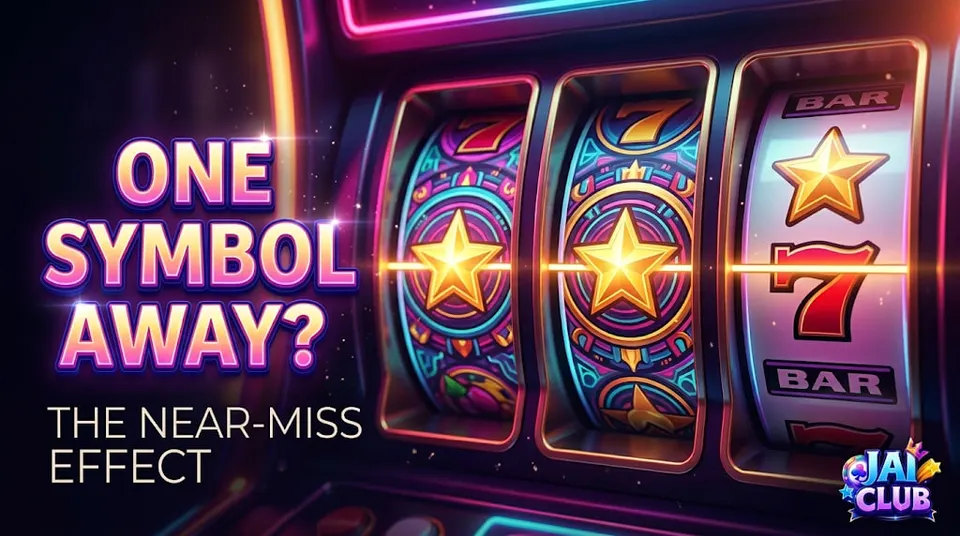
Two jackpot symbols appear on a slot machine. The third reel continues moving, slowing down as another matching symbol approaches the winning position.
For a moment, the result looks almost perfect.
Then the final symbol stops just outside the required position.
No jackpot is awarded.
Why does a slot near-miss feel so different from an ordinary losing result, even when both produce the same financial outcome?
The answer involves visual perception, expectations and how people respond to results that resemble successful outcomes.
In gambling research, this is commonly called the near-miss effect.
Near-misses can make an unsuccessful result feel unusually significant. However, the visual closeness of a symbol to a winning position does not establish that the next spin is more likely to succeed.
This article explains what near-misses are, why they attract attention and how to distinguish actual game results from psychologically compelling animations.
What Is a Near-Miss in Slot Games?
A near-miss occurs when an unsuccessful outcome closely resembles a winning combination.
Consider a simplified three-reel slot.
The required winning combination is:
Cherry – Cherry – Cherry
Now imagine two unsuccessful results.
Result A:
Cherry – Cherry – Lemon
Result B:
Lemon – Orange – Bell
Both results fail to produce the required combination.
However, Result A looks much closer to the winning pattern.
That visual similarity can make it feel like the player nearly succeeded.
The important distinction is that visual similarity is not the same as a partial financial win.
Unless the game's paytable specifically awards something for the displayed symbols, the near-miss does not create an additional payout.
Why Does Almost Winning Feel So Powerful?
Human perception is sensitive to patterns.
When two matching symbols appear, the viewer may naturally anticipate a third.
The closer the display appears to a winning combination, the stronger the sense of expectation can become.
This is not unique to slot games.
People often respond differently to an outcome that narrowly misses a goal compared with one that is clearly unsuccessful.
However, games of chance introduce a critical difference.
In an ordinary skill-based activity, a near-miss may provide useful feedback about performance.
For example, a basketball shot that narrowly misses the basket may reveal something about direction or force.
In a slot game, an almost-matching reel arrangement usually does not provide comparable information about improving the next result.
That is why a near-miss can feel informative without actually being predictive.
Near-Miss vs Ordinary Loss
| Feature | Near-Miss | Ordinary Loss |
|---|---|---|
| Visual appearance | Resembles a winning combination | Clearly different |
| Emotional response | May feel particularly close | Often less remarkable |
| Financial result | Depends on paytable | Depends on paytable |
| Predictive information | None established | None established |
| Next-spin advantage | Not established | Not established |
The distinction is largely about perception.
Two losing outcomes can feel very different even though they have the same settlement value.
That difference helps explain why near-misses receive so much attention in research on slot game design.
What Does Research Say About Near-Misses?
The near-miss effect has been examined for several decades.
Researchers have investigated how almost-winning results influence feelings, motivation, reaction times and subsequent decisions.
A 2024 study published in Psychology of Addictive Behaviors examined near-misses using simulated online slot machines.
Its experiments found that near-miss outcomes affected participants' subjective responses and some subsequent gambling behaviours, including faster continuation and increased stake sizes under the tested conditions.
However, that does not mean every near-miss produces the same effect in every person.
Research findings vary according to the experimental design, the specific visual stimuli and the behaviours being measured.
The central point is that a near-miss can influence how a result is experienced without providing useful information about future outcomes.
For further reading, see the published research: https://pubmed.ncbi.nlm.nih.gov/38709628/
Why the Third Reel Attracts So Much Attention
Consider a slot showing two matching symbols.
At that moment, the remaining reel appears to determine whether the complete combination will succeed.
The viewer may focus almost entirely on the last reel.
If the final symbol moves slowly past a desired position, the animation can create a strong impression of closeness.
However, the visible stopping sequence does not necessarily reveal the internal process used to determine the outcome.
In many software-based games, the result is generated through a defined mechanism and then presented through animation.
The animation is not automatically evidence that the game nearly selected a different outcome.
A symbol passing through a winning position during an animation should not be treated as a completed result.
Does a Symbol Stopping One Position Away Mean Anything?
Not necessarily.
Some people assume that a desired symbol stopping immediately above or below the payline means the next spin is likely to land on it.
That conclusion does not follow.
A symbol's position in a completed result must be interpreted according to the game's reel structure and paytable.
Its apparent physical distance from another symbol is not a universal measure of probability.
Two symbols may appear adjacent on a visual reel while having probabilities determined by software rules rather than by how close they look on the screen.
The actual game mathematics is what matters.
Near-Misses With Scatter Symbols
Scatter symbols can make near-miss experiences particularly noticeable.
Some slot games trigger bonus features when a specified number of Scatter symbols appears.
Imagine a fictional game that requires three Scatters.
A spin produces two Scatters, while the third reel displays an ordinary symbol.
The result might feel almost successful.
However, if the game's rules require three Scatters, two do not automatically trigger the same feature.
Some slots may award separate outcomes for fewer Scatters, but that depends entirely on the paytable.
This is why the game's actual symbol rules matter.
Our Wild vs Scatter Symbols Guide explains how special symbols can perform different functions.
Does a Near-Miss Mean a Bonus Is Coming?
No.
A near-miss does not establish that a bonus feature will appear in the next round.
Imagine the following fictional sequence:
Spin 1: Two Scatters
Spin 2: One Scatter
Spin 3: Two Scatters
Spin 4: No Scatters
A person might interpret these results as evidence that a three-Scatter bonus is approaching.
However, the history does not establish such a prediction.
If the game produces independent outcomes, each completed spin does not force the next spin to compensate for earlier near-misses.
Even where more complicated rules exist, the relevant rules must be verified rather than inferred from a short visual sequence.
Why Near-Misses Are Not Partial Wins
A partial win is a financial or game-defined outcome recognised by the paytable.
A near-miss is a descriptive term for an unsuccessful result that visually resembles a more favourable outcome.
These concepts should be kept separate.
For example, a spin could produce a small payout for one qualifying combination while simultaneously showing another combination that almost triggered a larger award.
The spin might then contain both a genuine small payout and a visual near-miss.
That does not mean the near-miss itself produced the payout.
Accurate interpretation requires identifying which symbols and combinations actually qualified.
Near-Miss vs Loss Disguised as a Win
These two concepts are related but different.
A near-miss is an unsuccessful outcome that looks close to success.
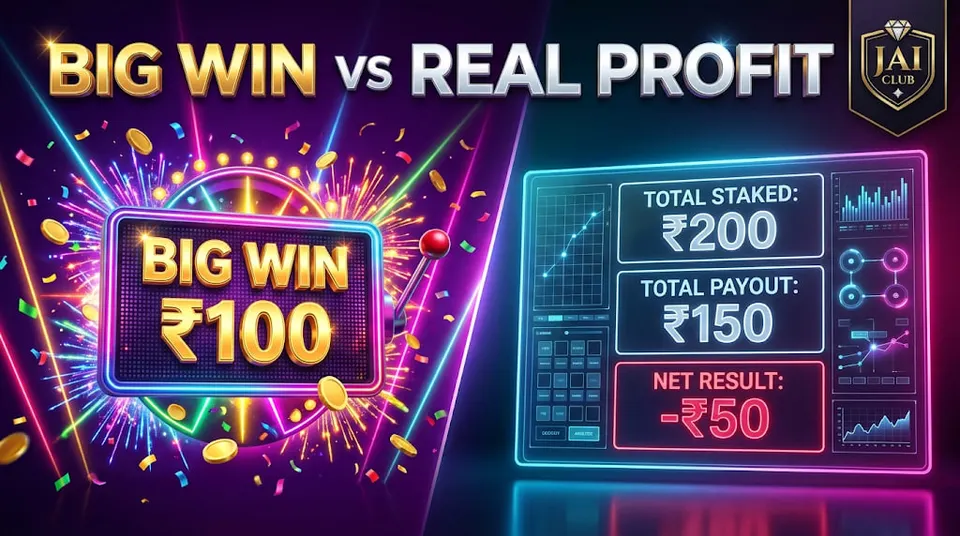
A loss disguised as a win describes a result where some amount is credited, but the payout is smaller than the stake, potentially accompanied by celebratory feedback.
Consider a fictional ₹20 spin.
Scenario A: The reels almost match a jackpot combination, but the payout is ₹0.
Scenario B: The reels produce a credited payout of ₹8, accompanied by positive sound effects.
In Scenario A, the player experiences a near-miss.
In Scenario B, the spin has a ₹12 net loss despite the credited amount.
Both situations can create misleading impressions if visual feedback is confused with financial results.
Can Near-Misses Affect Player Decisions?
Research suggests that near-misses can influence motivation and behaviour in some circumstances.
A visually close result may encourage a feeling that success was nearly achieved.
That feeling can be particularly strong when the display resembles a desired symbol combination.
However, experimental findings have not been perfectly uniform.
Different studies have reported different effects on continued play, emotional reactions and related behaviour.
The key point is not that every player responds identically.
It is that the design of the result display can affect human perception even when the financial outcome remains unchanged.
Understanding that distinction makes it easier to evaluate a game screen without assuming the emotional impression contains predictive information.
Does Pressing Stop Change a Near-Miss?
Some slot interfaces provide a stop or quick-stop control.
The effect of that control depends on the particular game's rules.
A button may shorten the animation rather than change an already determined outcome.
It should not be assumed that pressing Stop at the right moment can force a desired symbol to land on a payline.
Research has also examined how stop-button interfaces can contribute to perceptions of personal control.
But interface interaction and actual mathematical control are different concepts.
A physical action performed during an animation does not prove that the user can manipulate the underlying result.
Why Similar-Looking Outcomes Can Have Different Probabilities
A common mistake is to treat visual closeness as mathematical closeness.
For example, consider two five-digit sequences:
77777 and 77778.
They differ by only one digit.
However, under an independent uniform five-digit model, each specific sequence has the same probability.
The fact that one sequence visually resembles another does not change its individual mathematical likelihood.
Our article on 5D Lottery 77777 vs 12345 explores this distinction in more detail.
The same general reasoning helps explain why a visually close result is not automatically more informative about future outcomes.
Does RTP Account for Near-Misses?
RTP stands for Return to Player.
It is a theoretical long-run percentage associated with the game's payout mathematics.
Near-miss animations do not automatically change the monetary result of a spin.
However, the frequency and design of different outcomes may be features of a particular game's mathematics and presentation.
A valid RTP figure should come from the specific game version and its verified information.
It should not be inferred from how frequently the reels appear to come close to a jackpot.
A game with many dramatic near-misses does not automatically have a higher RTP.
How to Interpret Near-Misses Accurately
There are several useful distinctions to remember.
First, identify the actual completed combination rather than symbols appearing temporarily during an animation.
Second, check the paytable to see whether the completed result qualifies for a payout.
Third, separate the emotional feeling of closeness from the result's monetary value.
Fourth, avoid interpreting previous near-misses as evidence that a favourable outcome must occur soon.
Finally, remember that game animations and outcome generation are not necessarily the same process.
These principles help explain why a near-miss can feel meaningful even when it provides no reliable predictive advantage.
Frequently Asked Questions
What is a near-miss in slot games?
A near-miss is an unsuccessful result that visually resembles a winning combination.
Does a near-miss mean a win is coming?
No. A near-miss does not establish that the next spin will produce a winning combination.
Why do near-misses feel exciting or frustrating?
They resemble desired results and can trigger expectations, even when the financial outcome is unsuccessful.
Can two Scatters mean a bonus is close?
Two Scatters do not automatically guarantee that a three-Scatter bonus will occur soon.
Do slot machines deliberately create near-misses?
Near-miss presentation can be influenced by game design, but claims about a specific machine require evidence about its actual software and rules.
Can pressing Stop turn a near-miss into a win?
Do not assume a stop control changes the underlying outcome. Its functionality depends on the game.
Are near-misses included in RTP?
RTP concerns the game's payout mathematics. A visual near-miss does not automatically create a separate financial return.
Are near-misses the same as small wins?
No. A small win is a qualifying payout. A near-miss describes visual resemblance to an unsuccessful winning pattern.
Conclusion
Slot near-misses demonstrate the difference between how a result looks and what it actually means.
A combination that appears one symbol away from a jackpot can attract more attention than an ordinary loss.
However, visual closeness does not establish improved odds for the next spin.
Research shows that near-miss presentation can influence how people experience a game, but it does not create a reliable prediction system.
For further explanations of slot features, payout structures and other gaming formats, explore the Jai Club Games guide.
Almost winning is still different from winning, and a near-miss is not a promise about the next result.