5D Lottery 77777 vs 12345: Which Number Is Actually Rarer?
Is 77777 rarer than 12345 in a 5D lottery? Discover why both exact sequences have equal probability, how repeated-digit patterns work, and why unusual results can be misleading.
In this article
- 5D Lottery 77777 vs 12345: Which Number Is Actually Rarer?
- Why Does 77777 Look More Unusual Than 12345?
- How Many Possible Results Exist in a 5D Lottery?
- 77777 vs 12345: The Actual Probability
- Probability of 77777
- Probability of 12345
- Direct Comparison
- Then Why Are Five Identical Digits So Uncommon?
- What About Numbers With Five Different Digits?
- Are Repeated Digits Actually Common in 5D?
- Complete 5D Repeated-Digit Pattern Chart
- Why the Order of Digits Matters
- Does a Five-Digit Result Always Mean an Exact Five-Digit Selection?
- Why 00000 Is a Valid Five-Digit Sequence
- Can 77777 Appear Twice in a Row?
- Why Unusual Number Patterns Can Mislead People
- What Does This Mean for 5D Result History?
- 5D vs WinGo: Are the Number Probabilities Different?
- How Number Probability Differs From Payout Probability
- Three Important Lessons From the 77777 vs 12345 Comparison
- Frequently Asked Questions
- Is 77777 rarer than 12345 in a 5D lottery?
- What is the probability of getting 77777?
- How many five-digit lottery combinations are possible?
- What is the probability of five identical digits?
- Are repeated digits common in 5D results?
- Can 12345 appear in a lottery result?
- Is 00000 a valid five-digit result?
- Can the same 5D number appear twice consecutively?
- Does an unusual result prove that a lottery is rigged?
- Can previous 5D numbers predict the next result?
- Conclusion
5D Lottery 77777 vs 12345: Which Number Is Actually Rarer?
Imagine opening a 5D lottery result history and discovering the number 77777.
Five identical digits in a row would immediately attract attention. Some people might consider it almost impossible, while others might assume the result must be suspicious.
Now compare it with another five-digit result: 12345.
Which sequence is actually rarer?
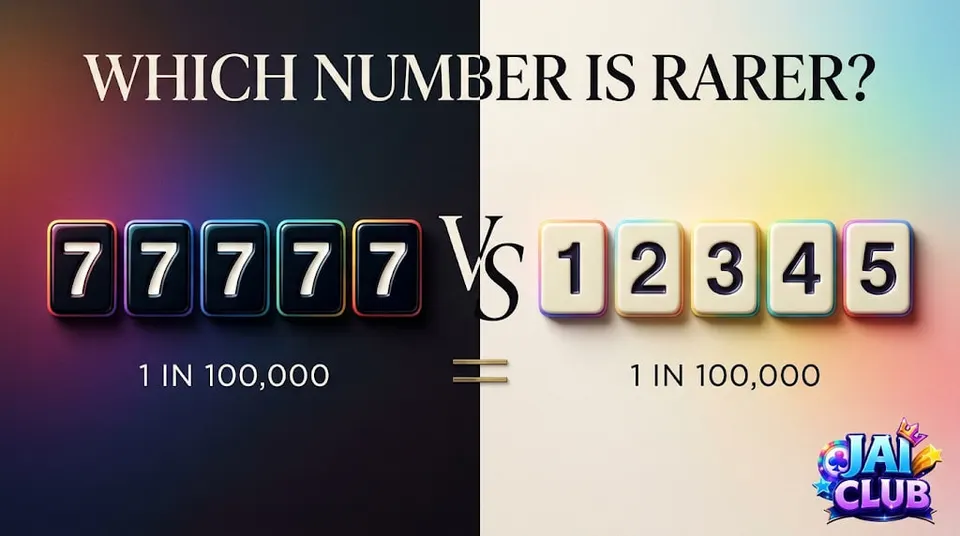
The surprising mathematical answer is that 77777 and 12345 have exactly the same probability when five positions are generated independently and each digit from 0 to 9 is equally likely.
Under that model, each specific sequence has a probability of 1 in 100,000.
However, there is an important difference between asking about one exact sequence and asking about an entire category of sequences.
That difference explains why repeated digits seem unusual, why some number patterns occur more frequently as groups, and why a strange-looking result does not automatically indicate anything about the next draw.
This article examines the mathematics behind 5D lottery number patterns. The probabilities are based on an ideal independent uniform-digit model, not an independent audit of any particular gaming platform.
Why Does 77777 Look More Unusual Than 12345?
Human beings are particularly sensitive to visible patterns.
A sequence containing five identical digits stands out immediately because every position matches.
By comparison, 12345 looks orderly and familiar because the numbers increase by one each time.
Both sequences are highly recognisable.
Yet their visual appearance does not determine their individual probability.
A number that looks special does not automatically have a different chance of being generated.
To understand why, we need to examine how five-digit sequences are counted.
How Many Possible Results Exist in a 5D Lottery?
A common 5D-style result contains five numerical positions.
These positions are often labelled A, B, C, D and E.
For the simplified model in this article, each position can contain any digit from 0 through 9.
That means each position has ten possibilities.
The total number of ordered five-digit sequences is:
10 × 10 × 10 × 10 × 10 = 100,000
The possible sequences range from 00000 through 99999.
Because every position matters, different arrangements count as different results.
For example:
- 12345
- 54321
- 15234
- 77777
- 00000
Each is one particular sequence.
Under the independent uniform model, all 100,000 sequences have equal probability.
This assumption is essential. A real game might use different outcome-generation rules, and those rules would need to be independently verified.
77777 vs 12345: The Actual Probability
Let's calculate the probability of each exact result.
Probability of 77777
For every position to contain the digit 7, five independent events must occur.
The probability is:
1/10 × 1/10 × 1/10 × 1/10 × 1/10
= 1/100,000
As a percentage:
0.001%
Probability of 12345
For this sequence, position A must contain 1, position B must contain 2, position C must contain 3, position D must contain 4, and position E must contain 5.
Again, the probability is:
1/10 × 1/10 × 1/10 × 1/10 × 1/10
= 1/100,000
As a percentage:
0.001%
Direct Comparison
| Exact Result | Probability | Percentage |
|---|---|---|
| 77777 | 1 in 100,000 | 0.001% |
| 12345 | 1 in 100,000 | 0.001% |
| 00000 | 1 in 100,000 | 0.001% |
| 90817 | 1 in 100,000 | 0.001% |
| 55555 | 1 in 100,000 | 0.001% |
Every row describes one exact five-digit sequence.
The mathematical probability is identical across the rows under the stated model.
That is why the visual uniqueness of 77777 does not make it less likely than the specific sequence 12345.
Then Why Are Five Identical Digits So Uncommon?
Here is where the comparison becomes more interesting.
There is a difference between asking:
"What is the probability of exactly 77777?"
and:
"What is the probability that all five digits are identical?"
The first question concerns one particular result.
The second concerns a whole category of results.
There are ten sequences in which all five digits are identical:
00000, 11111, 22222, 33333, 44444, 55555, 66666, 77777, 88888 and 99999.
So the probability that a five-digit result belongs to this category is:
10/100,000
= 0.01%
That is equivalent to 1 in 10,000 under the uniform model.
The probability of any five-identical-digit result is ten times the probability of one specific sequence such as 77777.
This is not a contradiction.
There are simply ten different qualifying results instead of one.
What About Numbers With Five Different Digits?
Now consider a completely different category.
Instead of asking for five identical digits, suppose we want all five positions to contain different digits.
The first position can contain any of ten digits.
The second position must be different from the first, leaving nine possibilities.
The third has eight remaining choices.
The fourth has seven.
The fifth has six.
The total number of sequences with five different digits is:
10 × 9 × 8 × 7 × 6 = 30,240
Therefore:
30,240/100,000 × 100
= 30.24%
This category includes many different sequences, such as 12345, 90817, 58302 and 76491.
Notice how large the difference is.
| Type of Result | Number of Possible Sequences | Probability |
|---|---|---|
| Exactly 77777 | 1 | 0.001% |
| Exactly 12345 | 1 | 0.001% |
| Any five identical digits | 10 | 0.01% |
| Any five different digits | 30,240 | 30.24% |
The probability of exactly 77777 remains equal to that of exactly 12345.
But the broader category of five different digits contains far more possible sequences than the category of five identical digits.
That is the key distinction between the probability of a specific result and the probability of a pattern category.
Are Repeated Digits Actually Common in 5D?
Yes, when we mean at least one repeated digit rather than all five digits being identical.
Under the uniform independent model, the probability of all five digits being different is 30.24%.
Therefore, the probability that at least one digit repeats is:
100% − 30.24%
= 69.76%
This result might seem surprising.
A sequence containing a repeated digit is mathematically more common than a sequence containing five completely different digits, under the assumed model.
For example:
- 11234 contains a repeated digit.
- 56775 contains a repeated digit.
- 22091 contains a repeated digit.
- 77777 contains repeated digits.
These sequences belong to different repeated-digit pattern categories.
The fact that they all contain repetition does not mean they are equally common as groups.
Complete 5D Repeated-Digit Pattern Chart
We can divide all 100,000 possible sequences into seven distinct pattern categories.
| Pattern Category | Example | Number of Sequences | Probability |
|---|---|---|---|
| Five different digits | 12345 | 30,240 | 30.24% |
| Exactly one pair | 11234 | 50,400 | 50.40% |
| Two pairs and one different digit | 11223 | 10,800 | 10.80% |
| Three matching, two different | 11123 | 7,200 | 7.20% |
| Three matching and one pair | 11122 | 900 | 0.90% |
| Four matching digits | 11112 | 450 | 0.45% |
| Five identical digits | 11111 | 10 | 0.01% |
| Total | 100,000 | 100% |
These categories do not overlap.
For instance, the "exactly one pair" category requires one repeated pair and three other digits that are all different from one another and from the pair.
The five-identical-digit category contains only ten possibilities.
The exactly-one-pair category contains 50,400 possibilities.
That explains why seeing a pair of matching digits is not particularly extraordinary in this mathematical model, even though seeing all five digits match is unusual.
Why the Order of Digits Matters
A five-digit result is an ordered sequence.
That means 12345 and 54321 are different results even though they contain the same five digits.
Similarly, 77123 and 12773 contain the same collection of digits, but their positions are different.
This matters in 5D formats because each position may be identified separately.
Imagine the following result:
A = 7, B = 7, C = 1, D = 2, E = 3
The complete sequence is 77123.
Rearranging the values creates a different sequence, even if the digits remain unchanged.
For mathematical probability calculations, an exact ordered result must not be confused with an unordered set of digits.
For a real platform, the specific rules determine whether a selection concerns one position, several positions, a sum or another outcome category.
Does a Five-Digit Result Always Mean an Exact Five-Digit Selection?
No.
A result containing five digits does not automatically mean the platform offers a single selection covering the entire sequence.
Some 5D interfaces focus on individual digit positions.
Others may display sum-based categories or additional classifications.
For example, a result of 77777 contains five individual sevens.
Its digit sum is:
7 + 7 + 7 + 7 + 7 = 35
A result of 12345 has a different sum:
1 + 2 + 3 + 4 + 5 = 15
Although both exact sequences have equal probability under our simplified model, their sums belong to different numerical outcomes.
The distribution of five-digit sums is not uniform.
Many different sequences can produce the same sum.
Therefore, a statement about the probability of one exact sequence should not automatically be applied to the probability of a sum-based result.
The two calculations answer different questions.
Why 00000 Is a Valid Five-Digit Sequence
A five-digit result may begin with zero.
This is an important distinction between a five-digit sequence and a five-digit positive integer.
The sequence 00000 contains five positions, each displaying zero.
Its mathematical probability is the same as 77777 under the independent uniform model.
Similarly, 01234 is a distinct ordered five-position result.
It should not be confused with a four-position result simply because an integer representation might remove its leading zero.
In a five-position format, the sequence length and position labels matter.
This is one reason result data is often better represented as text rather than automatically converted to an ordinary integer.
Can 77777 Appear Twice in a Row?
Mathematically, yes.
An unusual result is not prohibited from appearing again simply because it occurred recently.
Under independent uniform draws, the probability that a new result is exactly 77777 remains 1 in 100,000.
The previous appearance of 77777 does not make the next draw more or less likely to produce it.
There is also a subtle difference between two questions.
Question A: What is the probability that the next result is identical to the previous result, whatever that previous result was?
Under the model, the answer is 1 in 100,000.
Question B: What is the probability that two specified consecutive draws are both exactly 77777?
Under the independent model, the answer is:
1/100,000 × 1/100,000
= 1 in 10,000,000,000
The second event is much more specific.
Confusing these two questions can lead to exaggerated conclusions about repeated lottery results.
Why Unusual Number Patterns Can Mislead People
People often expect randomness to look irregular.
A sequence such as 68194 may feel more random than 77777 or 12345.
But an independently generated sequence does not need to look messy to be random.
Perfectly repeated digits, ascending numbers and visually attractive arrangements can all occur naturally.
The appearance of a recognisable pattern does not establish that a result was manipulated.
At the same time, the appearance of a particular sequence does not prove that a system is fair.
Establishing the fairness of a real game requires evidence about its actual outcome-generation process, published rules and any relevant independent verification.
A single result, however unusual, is not sufficient evidence in either direction.
What Does This Mean for 5D Result History?
A result history usually records completed outcomes.
A reader may notice that certain digits appear repeatedly or that some rounds contain matching pairs.
These observations can be mathematically interesting.
However, they should not be mistaken for reliable forecasts.
For example, seeing 77777 does not establish that the next round will contain five different digits.
Likewise, a long series of results without all five digits matching does not mean an identical-digit result must appear soon.
Historical frequencies also require careful interpretation.
A sample containing a few dozen results may differ considerably from long-run mathematical expectations.
Even a larger dataset cannot automatically reveal the mechanism of a platform without considering how the data was generated.
5D vs WinGo: Are the Number Probabilities Different?
A common WinGo format describes one numerical result between 0 and 9.
A 5D-style result contains five positions.
Under a uniform single-digit model, one particular WinGo digit has a probability of 1 in 10.
Under a uniform five-independent-digit model, one particular five-digit sequence has a probability of 1 in 100,000.
These models answer different questions because the result structures are different.
Some WinGo guides also classify individual digits as Big/Small or Odd/Even.
Our article on WinGo Big Small vs Odd Even number groups explains those classifications.
A five-digit lottery sequence should not be treated as equivalent to a single WinGo number merely because both formats use digits from 0 to 9.
How Number Probability Differs From Payout Probability
Another important distinction is the difference between the probability of a result and the financial return associated with it.
Even if two exact sequences are equally likely, that does not imply every available game option has the same payout.
Different selections may correspond to individual positions, numerical totals, repeated-digit patterns or other categories.
The payout must be examined separately from the probability of the underlying outcome.
Our related article, Colour Trading 2× vs 4.5×: Why Bigger Payouts Can Be Misleading, examines that distinction through expected-return calculations.
The general mathematical principle applies across many chance-based games: the size of a displayed reward does not establish its expected value without the probability and settlement rules.
Three Important Lessons From the 77777 vs 12345 Comparison
The first lesson is that a recognisable pattern is not necessarily an individually rarer result.
Exactly 77777 and exactly 12345 each represent one possible outcome out of 100,000 under the uniform independent model.
The second lesson is that pattern categories can have very different probabilities.
There are only ten five-identical-digit sequences, but 30,240 sequences with five different digits.
The third lesson is that past results do not guarantee future outcomes.
Neither a surprising result nor a long sequence of ordinary-looking numbers provides a guaranteed prediction about the next draw.
Understanding these distinctions helps separate mathematical reasoning from visual impressions.
Frequently Asked Questions
Is 77777 rarer than 12345 in a 5D lottery?
No. Under an independent uniform-digit model, both exact sequences have the same probability of 1 in 100,000.
What is the probability of getting 77777?
The probability is 0.001%, assuming each of the five positions independently produces a uniformly distributed digit between 0 and 9.
How many five-digit lottery combinations are possible?
There are 100,000 ordered sequences when leading zeros are allowed and each position can contain any digit from 0 to 9.
What is the probability of five identical digits?
Any five-identical-digit sequence has a combined probability of 0.01% under the uniform model.
Are repeated digits common in 5D results?
At least one repeated digit occurs in 69.76% of all five-digit sequences under the independent uniform model.
Can 12345 appear in a lottery result?
Yes. It is one of the possible five-digit sequences, assuming the game allows the full 00000–99999 range.
Is 00000 a valid five-digit result?
It is valid in a five-position model that allows zero in every position. A specific platform's rules and result representation should be checked.
Can the same 5D number appear twice consecutively?
Yes. Repetition is mathematically possible. Under independent uniform draws, the probability that the next result matches a given previous result is 1 in 100,000.
Does an unusual result prove that a lottery is rigged?
No. A surprising pattern alone does not establish whether a system is fair or manipulated. Such conclusions require independent evidence.
Can previous 5D numbers predict the next result?
A previous sequence does not guarantee a future result. Under independent uniform generation, the next exact sequence has the same probability regardless of earlier draws.
Conclusion
The comparison between 77777 and 12345 reveals one of the most interesting properties of five-digit probability.
Although 77777 looks extremely unusual, its probability is identical to that of 12345 when both are treated as exact ordered sequences under a uniform independent model.
The difference appears when we compare entire groups rather than individual results.
Only ten sequences contain five identical digits, while 30,240 sequences contain five different digits.
This explains why identical-digit patterns are uncommon as a category even though each individual five-digit sequence has the same theoretical probability.
For more information about WinGo, K3, 5D and other gaming formats, explore the Jai Club Game overview.
Random results do not have to look random to the human eye. Understanding the mathematics is more useful than judging a sequence by its appearance.