
K3 Triple 444 vs Sum 12: One Result, Two Different Questions
K3 triple 444 and sum 12 describe the same dice result in two different ways. Explore exact triples, dice combinations, total probabilities and why identical sums do not always mean identical patterns.
In this article
- K3 Triple 444 vs Sum 12: One Result, Two Different Questions
- What Does Triple 444 Mean in K3?
- What Does Sum 12 Mean in K3?
- K3 Triple 444 vs Sum 12 Comparison
- How Many K3 Dice Combinations Are Possible?
- What Is the Probability of Triple 444?
- What Is the Probability of Any Triple?
- What Is the Probability of Sum 12?
- Why Does Triple 444 Count as Sum 12?
- Does a Triple Count as Big or Small in K3?
- How Are Triples Different From Doubles?
- Can Every K3 Sum Contain a Triple?
- Why Do Different Dice Patterns Produce the Same Sum?
- How to Read a K3 Result Chart
- Why a Triple Does Not Predict the Next Sum
- Does Triple 444 Have a Higher Payout Than Sum 12?
- K3 Compared With WinGo Number Classification
- Frequently Asked Questions
- Is K3 triple 444 the same as sum 12?
- What is the probability of triple 444?
- What is the probability of sum 12?
- How many K3 triples are possible?
- Does every sum of 12 contain matching dice?
- Is triple 444 Big or Small?
- Can a K3 triple predict the next result?
- Are exact triples and sum selections always paid differently?
- Conclusion
K3 Triple 444 vs Sum 12: One Result, Two Different Questions
Three dice appear on a K3 result screen.
Every die shows the number 4.
The completed result is:
4 + 4 + 4 = 12
This creates an interesting mathematical question.
Is the result a K3 triple 444, or is it a sum of 12?
The answer is both.
Triple 444 describes the exact values appearing on the three dice. Sum 12 describes their combined numerical total.
However, these two descriptions represent different categories.
One concerns a specific dice combination. The other concerns a total that can be produced in multiple ways.
Understanding that distinction is essential when interpreting K3 result charts, triple symbols and number-based categories.
This guide explains the mathematics using an ideal model of three independent fair six-sided dice. It does not establish the current settlement rules or probabilities of any particular Jai Club implementation.
What Does Triple 444 Mean in K3?
A triple occurs when all three dice show the same number.
Examples include:
- 1-1-1
- 2-2-2
- 3-3-3
- 4-4-4
- 5-5-5
- 6-6-6
There are six possible triples when three ordinary six-sided dice are used.
Triple 444 is one specific member of this group.
All three dice must show 4.
A result such as 4-4-5 is not a triple because the third die is different.
Likewise, 3-4-5 is not a triple even though its combined sum is also 12.
A triple is therefore defined by matching individual dice values, not by the total alone.
What Does Sum 12 Mean in K3?
A K3 sum is calculated by adding the values of all three dice.
For example:
3 + 4 + 5 = 12
Another result is:
2 + 4 + 6 = 12
And another is:
4 + 4 + 4 = 12
All three examples produce the same total.
However, they contain different individual dice values.
This means a sum category includes more possible outcomes than one particular exact triple.
The difference between a sum and a combination is fundamental to three-dice mathematics.
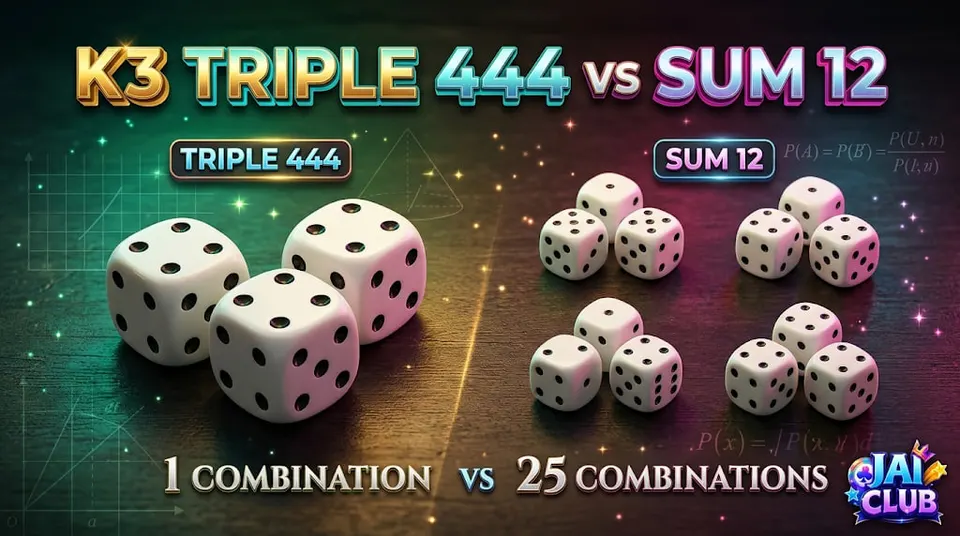
K3 Triple 444 vs Sum 12 Comparison
| Feature | Triple 444 | Sum 12 |
|---|---|---|
| What it describes | Exact dice combination | Combined total |
| Required dice | 4, 4, 4 | Any three dice adding to 12 |
| Number of ordered outcomes | 1 | 25 |
| Fair-dice probability | About 0.46% | About 11.57% |
| Requires matching dice | Yes | No |
| Can include 444 | Yes | Yes |
| Is it one specific result? | Yes | No |
This table explains why the categories should not be treated as interchangeable.
Triple 444 is a single exact arrangement.
Sum 12 is a broader category containing multiple arrangements.
Both descriptions can apply to the same completed result.
How Many K3 Dice Combinations Are Possible?
Each standard six-sided die has six possible values.
With three independent dice, the number of ordered combinations is:
6 × 6 × 6 = 216
Ordered combinations matter because each die occupies a distinguishable position.
For example:
1-2-3
1-3-2
2-1-3
All produce the same sum of 6.
However, they represent different ordered outcomes when the dice are treated as distinguishable.
In an ideal fair-dice model, each ordered combination has probability:
1 ÷ 216
= approximately 0.46%
The probability of an entire sum category depends on how many ordered outcomes belong to that category.
What Is the Probability of Triple 444?
Triple 444 requires all three dice to show 4.
The probability of a single fair die showing 4 is:
1/6
For three independent dice:
1/6 × 1/6 × 1/6
= 1/216
As a percentage:
Approximately 0.463%
This calculation describes one specific triple.
It is different from the probability of any triple.
What Is the Probability of Any Triple?
There are six possible triples.
Each is one exact ordered combination.
Therefore:
6 ÷ 216
= 1/36
= approximately 2.78%
This result includes every triple from 111 through 666.
The probability of triple 444 is smaller because it represents just one of those six outcomes.
What Is the Probability of Sum 12?
A total of 12 can be formed by several different groups of dice values.
The possible unordered groups are:
1-5-6
2-4-6
3-4-5
2-5-5
3-3-6
4-4-4
Some groups produce six different ordered arrangements.
Others produce three.
Triple 444 produces only one.
The complete count is:
| Dice Values | Ordered Arrangements | Sum |
|---|---|---|
| 1-5-6 | 6 | 12 |
| 2-4-6 | 6 | 12 |
| 3-4-5 | 6 | 12 |
| 2-5-5 | 3 | 12 |
| 3-3-6 | 3 | 12 |
| 4-4-4 | 1 | 12 |
| Total | 25 |
Therefore, the probability of sum 12 under the fair-dice model is:
25 ÷ 216
= approximately 11.57%
This is much greater than the probability of triple 444 alone.
The reason is simple: sum 12 can be produced through 25 ordered outcomes, while triple 444 has only one.
Why Does Triple 444 Count as Sum 12?
Because the sum category is based on addition.
Triple 444 satisfies the calculation:
4 + 4 + 4 = 12
It also satisfies the definition of a triple because the dice values are identical.
These classifications overlap.
A single outcome can therefore belong to several descriptive categories simultaneously.
For example, the result 4-4-4 can be described mathematically as:
- An exact triple
- A combination of three matching dice
- A total of 12
- An even sum
- A sum within the upper half of the 3–18 range
However, this does not mean every game automatically awards every possible selection associated with those categories.
Settlement rules may define exceptions.
Does a Triple Count as Big or Small in K3?
This is an important area where game versions can differ.
In a simple mathematical classification, sums from 3 to 10 may be labelled Small and sums from 11 to 18 may be labelled Big.
Under that description, sum 12 belongs to Big.
However, some K3 implementations exclude triple outcomes from ordinary Big/Small settlement or apply special conditions to them.
That means a result such as 4-4-4 might have a mathematical sum of 12 while receiving separate treatment under the game's selection rules.
The mathematical category and the actual settlement condition are not always identical.
Before interpreting a result as a qualifying outcome, check the specific game's published instructions.
Do not assume that the word Big guarantees a particular settlement for a triple.
How Are Triples Different From Doubles?
A double occurs when exactly two dice have the same value.
For example:
4-4-5
The first two dice match, while the third is different.
A triple requires all three values to match.
Compare the following results.
| Dice Result | Pattern | Sum |
|---|---|---|
| 4-4-4 | Triple | 12 |
| 4-4-5 | Exactly one pair | 13 |
| 4-5-4 | Exactly one pair | 13 |
| 3-4-5 | Three different | 12 |
| 2-5-5 | Exactly one pair | 12 |
| 1-5-6 | Three different | 12 |
Notice that a sum of 12 can occur with a triple, a pair or three different values.
The sum does not uniquely determine the pattern.
Can Every K3 Sum Contain a Triple?
No.
A triple with value n has total 3n.
For ordinary six-sided dice, the six triple totals are:
| Triple | Sum |
|---|---|
| 111 | 3 |
| 222 | 6 |
| 333 | 9 |
| 444 | 12 |
| 555 | 15 |
| 666 | 18 |
Every triple sum is a multiple of 3.
However, not every result whose sum is divisible by 3 is a triple.
For example:
1 + 4 + 4 = 9
The total is 9, but the values are not all identical.
Similarly:
2 + 4 + 6 = 12
The total is divisible by 3, but the combination is not a triple.
This distinction prevents an easy mathematical misunderstanding.
Why Do Different Dice Patterns Produce the Same Sum?
Addition is many-to-one.
Different sets of values can produce the same total.
For example:
2 + 4 + 6 = 12
3 + 3 + 6 = 12
4 + 4 + 4 = 12
The sum loses information about the individual dice arrangement.
Knowing only the total 12 does not reveal which of the 25 ordered combinations occurred.
This is why a result history showing only the sum provides less information than a history displaying all three dice.
A complete K3 record may contain the period identifier, individual dice values, combined sum and separate classification labels.
Each field contributes different information.
How to Read a K3 Result Chart
Suppose a fictional history displays the following completed outcomes.
| Period | Dice | Sum | Pattern |
|---|---|---|---|
| K001 | 4-4-4 | 12 | Triple |
| K002 | 3-4-5 | 12 | Three different |
| K003 | 2-5-5 | 12 | Exactly one pair |
| K004 | 1-2-3 | 6 | Three different |
| K005 | 6-6-6 | 18 | Triple |
These are illustrative results.
The first three rows have the same sum.
However, their patterns differ.
A user looking only at the SUM column would not see that difference.
That is why individual dice values should be examined when interpreting triple-related information.
The period identifier is also important because it connects each result to a specific completed round.
Why a Triple Does Not Predict the Next Sum
A triple can attract attention because matching dice appear visually unusual.
However, the appearance of 444 does not establish that a particular result will follow.
For independent fair dice, the probability distribution remains the same from one roll to the next.
Previous outcomes do not force future dice to compensate.
For example, a triple 444 does not make another triple impossible in the following round.
Likewise, it does not make sum 10 or 11 guaranteed.
The same principle applies to other game formats.
Our article on 5D Lottery 77777 vs 12345 explains why memorable number patterns do not automatically have different individual probabilities.
Does Triple 444 Have a Higher Payout Than Sum 12?
A specific triple is mathematically rarer than the broader sum-12 category under the fair-dice model.
However, that does not automatically establish the exact payout difference.
Payouts are defined by the game operator's settlement rules.
The multiplier, stake conditions and any special exceptions need to be verified from the relevant game.
A rare outcome is not necessarily a favourable financial opportunity.
The expected return depends on both the event's probability and the applicable payout.
For that reason, this article does not assign an invented payout multiplier to triple 444 or sum 12.
K3 Compared With WinGo Number Classification
K3 uses three dice and their numerical relationships.
WinGo commonly uses one digit between 0 and 9.
Therefore, a K3 sum of 12 cannot be interpreted like a WinGo result of 12, because the common single-digit WinGo format does not produce a two-digit result.
Likewise, a triple 444 has no direct equivalent in a one-digit WinGo outcome.
Our WinGo Big Small vs Odd Even Guide explains how a single digit can be assigned different mathematical labels.
Both games demonstrate that classifications require context, but their underlying result structures remain different.
Frequently Asked Questions
Is K3 triple 444 the same as sum 12?
Triple 444 produces sum 12, but sum 12 can also be produced through many other dice combinations.
What is the probability of triple 444?
For three independent fair six-sided dice, the probability is 1 in 216, approximately 0.46%.
What is the probability of sum 12?
There are 25 ordered combinations producing a total of 12 out of 216 possibilities, or approximately 11.57%.
How many K3 triples are possible?
There are six exact triples: 111, 222, 333, 444, 555 and 666.
Does every sum of 12 contain matching dice?
No. For example, 3-4-5 and 2-4-6 both produce a sum of 12 without matching dice.
Is triple 444 Big or Small?
Its mathematical sum is 12, which belongs to the upper group under a common classification. However, some games apply special settlement rules to triples.
Can a K3 triple predict the next result?
No reliable prediction follows from the previous occurrence of a triple.
Are exact triples and sum selections always paid differently?
The actual settlement depends on the particular game's published rules and cannot be assumed from mathematical probability alone.
Conclusion
K3 triple 444 and sum 12 demonstrate the difference between an exact dice combination and a broader numerical category.
Triple 444 describes one specific outcome: three dice showing 4.
Sum 12 describes 25 possible ordered outcomes under the fair-dice model, including triple 444.
A single result can belong to both categories, but their mathematical probabilities and game-defined settlement conditions are different questions.
For further information about K3, 5D, WinGo and other numerical game formats, explore the Jai Club Games overview.
The same result can have several correct descriptions, but those descriptions do not necessarily carry the same rules or probabilities.