Same Number, Different Meaning: How Results Change Across Jai Club Games
Why does the same number mean different things in WinGo, K3 and 5D? Explore how Jai Club games use single digits, dice totals, number positions, slot multipliers and different result formats.
In this article
- Same Number, Different Meaning: How Results Change Across Jai Club Games
- Why Can One Number Have Several Meanings?
- What Does Number 5 Mean in WinGo?
- What Does Number 5 Mean in K3?
- Why Does This Matter?
- Number 5 in a 5D Lottery
- Why Is Position Important?
- WinGo vs K3 vs 5D: Result Comparison
- Are the Probabilities of Number 5 the Same?
- What Does Number 5 Mean in Slot Games?
- Why Slot Symbols Make Results More Complex
- Crash Games: Multipliers Instead of Fixed Lottery Numbers
- Result Number vs Period Number
- Why Does the Same Digit Appear Repeatedly?
- The Difference Between a Result and a Payout
- Common Mistakes When Comparing Game Results
- Mistake 1: Treating Every 5 as the Same Event
- Mistake 2: Ignoring the Number of Positions
- Mistake 3: Confusing Multipliers With Results
- Mistake 4: Treating Period Identifiers as Outcome Patterns
- Mistake 5: Applying One Game's Rules to Another
- How to Read Different Jai Club Game Results
- Why This Matters for Result History Charts
- Frequently Asked Questions
- Is number 5 the same in WinGo and K3?
- What does number 5 mean in 5D?
- Are the probabilities identical across these games?
- Is a period number part of the game result?
- Does 5× in a slot mean the same as WinGo number 5?
- Can the same numbers appear in multiple games?
- Can matching numbers across games predict future outcomes?
- Conclusion
Same Number, Different Meaning: How Results Change Across Jai Club Games
Imagine three different gaming results appearing on the same screen.
WinGo displays the number 5. K3 also displays a result of 5. Meanwhile, a 5D lottery shows the digit 5 in its first position.
Do all three numbers mean the same thing?
No. Although the digit looks identical, its meaning depends entirely on the game format.
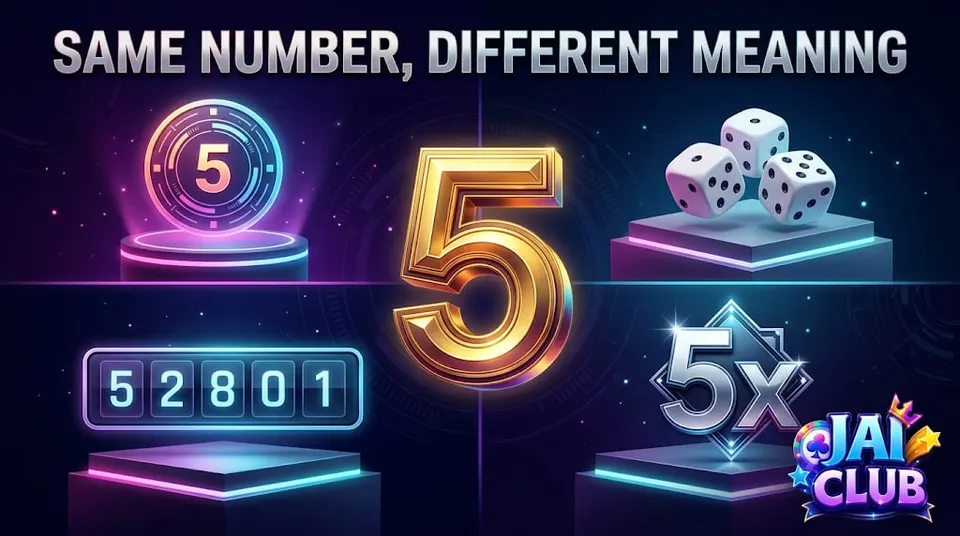
In WinGo, 5 can represent the complete numerical outcome. In K3, 5 may represent the combined sum of three dice. In 5D, the same digit might occupy one position within a five-number sequence.
This difference becomes even more interesting when numbers appear in slot games, crash multipliers and account balances.
This article explains why identical-looking numbers can represent different events across Jai Club games, how their mathematical properties differ and why results from unrelated games should not be interpreted using the same rules.
Why Can One Number Have Several Meanings?
A number is meaningful only when its context is known.
Consider the number 10.
It could represent:
- Ten seconds remaining on a countdown
- A total of ten from three dice
- Ten rupees recorded as a stake
- A game period ending in 10
- A 10× multiplier
- Part of a larger lottery sequence
These are not interchangeable measurements.
Each number belongs to a particular field, such as a timer, result, transaction or multiplier.
The same principle applies when comparing different online games.
Before interpreting any numerical value, it is necessary to understand what the game is measuring.
What Does Number 5 Mean in WinGo?
WinGo is commonly described as a game that produces a single numerical result between 0 and 9.
In a familiar classification system:
Small: 0, 1, 2, 3, 4
Big: 5, 6, 7, 8, 9
The digit 5 therefore belongs to the Big category.
It is also an odd number.
Some WinGo formats associate individual digits with colour classifications, including special associations for 0 and 5.
However, the important characteristic is that the digit 5 represents one complete numerical result.
It is not a sum calculated from several dice.
It is not one position within a longer five-digit number.
Our article on WinGo Big Small vs Odd Even explains these classifications further.
What Does Number 5 Mean in K3?
K3 commonly uses three dice or three numerical values representing dice faces.
Each standard die can produce a value between 1 and 6.
The combined result is calculated by adding the three values.
For example:
1 + 1 + 3 = 5
Another combination is:
1 + 2 + 2 = 5
Both combinations have the same sum.
That creates an important difference from WinGo.
In WinGo, number 5 can be one complete single-digit outcome.
In K3, a sum of 5 can be formed through several three-dice arrangements.
Why Does This Matter?
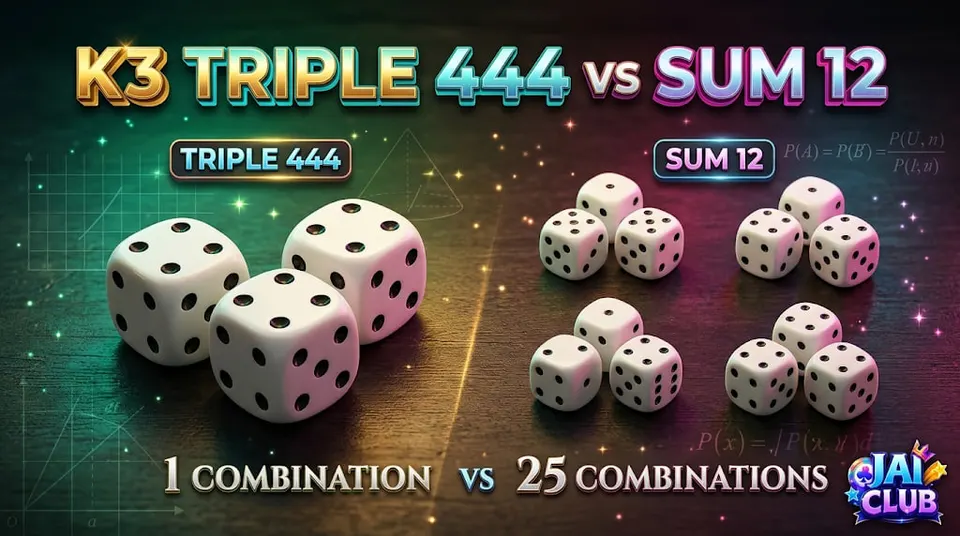
For three independent fair six-sided dice, there are 216 possible ordered outcomes.
A sum of 5 can occur through six ordered combinations.
Its theoretical probability is:
6 ÷ 216 × 100 = approximately 2.78%
Compare this with an ideal uniform single-digit model in which each digit from 0 to 9 has a probability of 10%.
These probabilities are different because the underlying events are different.
A WinGo result of 5 and a K3 total of 5 should not be treated as equivalent.
The figures are theoretical mathematical examples, not independently verified probabilities for a specific gaming platform.
Number 5 in a 5D Lottery
A 5D-style result generally contains five numerical positions.
These positions may be labelled A, B, C, D and E.
Imagine the result:
5 2 8 0 1
The first position contains 5.
The complete sequence is 52801.
Now consider another result:
1 5 5 3 7
This sequence contains the digit 5 twice.
Although both examples include the same digit, they represent different five-position outcomes.
In position-based formats, the location of a digit can matter as much as the digit itself.
Why Is Position Important?
Consider these two sequences:
12345
54321
They contain the same five different digits.
However, they are not identical ordered sequences.
The first position is different, the second position is different, and the overall order has changed.
That is why a five-position result should not automatically be treated as an unordered collection of digits.
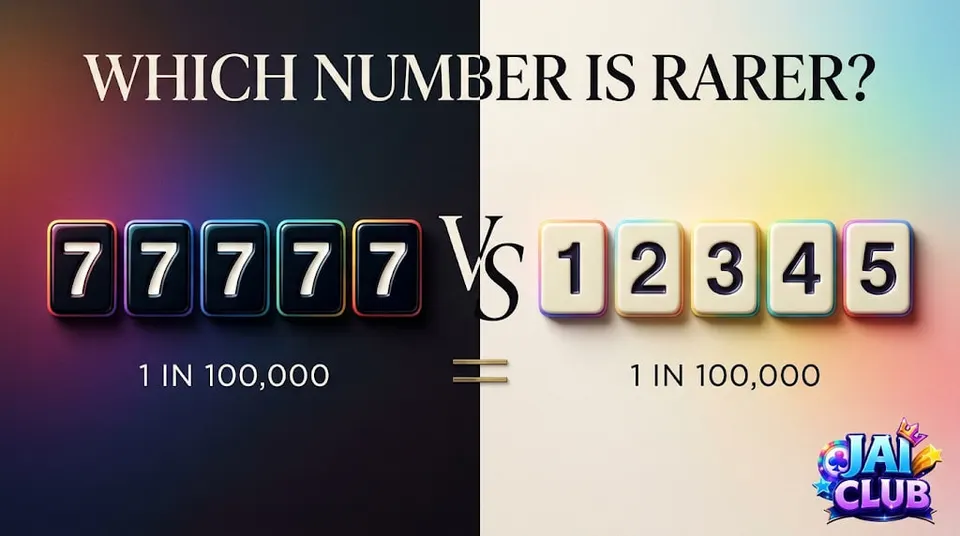
Our article on 5D Lottery 77777 vs 12345 examines why exact five-digit sequences have equal theoretical probabilities under a uniform independent model.
WinGo vs K3 vs 5D: Result Comparison
| Feature | WinGo | K3 | 5D |
|---|---|---|---|
| Common result | One digit | Three dice | Five digits |
| Numerical range | 0–9 | 1–6 per die | 0–9 per position |
| Meaning of 5 | Complete digit result | Possible dice total | Value in a position |
| Order important? | Not within one digit | May matter for combinations | Important for positions |
| Sum calculation | Usually unnecessary | Central to many formats | May apply to some categories |
| Common result history | Period and digit | Period and dice values | Period and digit sequence |
This comparison demonstrates why identical numerical symbols can represent different mathematical events.
Are the Probabilities of Number 5 the Same?
No universal equality can be assumed.
Under simplified independent models, the theoretical probabilities differ according to the event being measured.
| Event | Theoretical Probability |
|---|---|
| WinGo digit equals 5 | 10% |
| K3 dice sum equals 5 | About 2.78% |
| One specified 5D position equals 5 | 10% |
| Entire 5D sequence equals 52801 | 0.001% |
These figures rely on ideal mathematical assumptions.
They are not proof that a particular game provider uses independently generated uniform outcomes.
The table also illustrates why comparing unrelated result categories without context is misleading.
What Does Number 5 Mean in Slot Games?
Slots introduce another kind of result system.
Instead of displaying one main lottery digit, most conventional slot games evaluate combinations of symbols on reels.
The screen may also show values such as stakes, payouts and multipliers.
For example:
Stake: ₹10
Payout: ₹50
Multiplier: 5×
Here, the number 5 represents a payout multiple.
It is not a WinGo result of 5 or a K3 dice total of 5.
The multiplier describes a relationship between the payout and the amount staked.
A 5× total-return multiplier means the payout is five times the relevant stake under the stated definition.
This is different from a five-digit lottery result or a single-digit outcome.
Why Slot Symbols Make Results More Complex
A slot outcome may depend on the arrangement of multiple symbols.
A winning combination might involve three matching symbols, special substitute symbols or game-specific features.
Some games use paylines, while others apply alternative matching systems.
Therefore, a single displayed number cannot necessarily summarise the entire result.
A slot payout may also be affected by a bonus multiplier.
A result containing a 5× multiplier is not automatically five times more likely or less likely than a result containing a 2× multiplier.
The exact probability and settlement rules depend on the game mathematics.
Crash Games: Multipliers Instead of Fixed Lottery Numbers
Crash-style games introduce another distinctive number format.
An active round may display a multiplier that changes as the game progresses.
For example:
1.00× → 1.25× → 1.70× → 2.40×
These figures are not a series of completed lottery results.
They describe multiplier levels within an active round.
The number 2.40× cannot be compared directly with a WinGo result of 2 or a K3 total of 4.
They represent different quantities.
For a related explanation of how these games organise their rounds, see Which Jai Club Games Have Timers, and Which Don't?.
Result Number vs Period Number
Another source of confusion is the difference between a result and its period identifier.
Many timed games display both.
Consider this fictional example:
Period: 202611020145
Result: 5
The long numerical identifier identifies a particular round.
The digit 5 represents the result associated with that round.
The period number is not part of the result itself.
Some users mistake a long identifier for a hidden numerical pattern.
However, the identifier may simply follow a defined naming or sequencing system.
A pattern within period identifiers does not establish a corresponding pattern in the results.
Why Does the Same Digit Appear Repeatedly?
A digit such as 5 may appear several times across different games or consecutive rounds.
That does not automatically mean the underlying outcomes are connected.
For instance, a WinGo result of 5 and a 5D result containing 5 may arise through entirely separate processes.
Even within one game, repeated values can occur naturally.
The key questions are whether the outcomes belong to the same system, how they are generated and what the specific event represents.
An apparent pattern across unrelated formats does not provide a reliable forecast.
The Difference Between a Result and a Payout
A result describes what happened in the game.
A payout describes the amount credited according to the settlement rules.
These should not be confused.
Two results may have the same numerical value but lead to different credited amounts because they involve different selection types or stakes.
Similarly, a high displayed payout does not mean that the underlying event was necessarily more likely.
Our article on Big Win Animations vs Real Slot Profit explains why the amount credited for one event is different from the overall financial result of a session.
Common Mistakes When Comparing Game Results
Mistake 1: Treating Every 5 as the Same Event
A WinGo digit, K3 dice total and 5D position are different kinds of results.
Mistake 2: Ignoring the Number of Positions
A five-digit sequence cannot be interpreted like a single-digit result.
Mistake 3: Confusing Multipliers With Results
A 5× multiplier describes a ratio, not necessarily a drawn number.
Mistake 4: Treating Period Identifiers as Outcome Patterns
Period numbers identify rounds and do not automatically contain predictive information.
Mistake 5: Applying One Game's Rules to Another
Big/Small, colour mapping, dice combinations and slot paylines are not interchangeable systems.
How to Read Different Jai Club Game Results
A simple method can prevent many misunderstandings.
First, identify the game category.
Next, determine whether the displayed figure represents a result, period identifier, countdown, stake or multiplier.
Then check the number of positions involved.
If the result contains several digits or dice, establish whether their order matters.
Finally, review the particular game's rules before applying a classification.
This approach is more useful than assuming every numerical result follows one universal system.
Why This Matters for Result History Charts
A history chart records completed events.
However, different charts may display different types of information.
A WinGo history may show digits and colours.
A K3 history may show three dice and a sum.
A 5D history may show five positions.
A slot history may focus on individual rounds and credited payouts.
These datasets cannot be compared meaningfully without accounting for their different structures.
For example, a K3 sum of 10 does not have the same meaning as a single WinGo digit, since 10 is outside the 0–9 WinGo result range.
Likewise, a slot multiplier of 10× represents another kind of quantity entirely.
Frequently Asked Questions
Is number 5 the same in WinGo and K3?
No. WinGo commonly uses a single-digit result, while K3 uses three dice and may display their combined total.
What does number 5 mean in 5D?
It can represent a digit in one of five positions. The precise significance depends on the relevant selection rules.
Are the probabilities identical across these games?
Not necessarily. Different game formats have different outcome structures and theoretical probability models.
Is a period number part of the game result?
No. A period number generally identifies the round associated with a completed result.
Does 5× in a slot mean the same as WinGo number 5?
No. A slot multiplier describes a ratio, while WinGo number 5 is a numerical result.
Can the same numbers appear in multiple games?
Yes. Similar digits can appear independently across different result systems.
Can matching numbers across games predict future outcomes?
No reliable prediction follows from numerical similarities alone.
Conclusion
The same numerical symbol can have several different meanings across Jai Club games.
In WinGo, 5 may represent one complete digit result. In K3, it may be the sum of three dice. In 5D, it can occupy one of five numerical positions.
Slots and crash games introduce further distinctions through payouts and multipliers.
Understanding these differences is essential for reading result histories correctly.
For a broader introduction to the various gaming formats, explore the Jai Club Games overview.
Before interpreting any number, identify what that number actually measures.