Fishing Game Cannon Power vs Reward Value: Why Stronger Isn't Always Better
Does higher cannon power improve fishing game rewards? Understand Jai Club fishing cannon levels, stake per shot, fish multipliers, auto-fire costs and why stronger weapons do not guarantee better returns.
In this article
- What Is a Fishing Arcade Game?
- What Does Cannon Power Mean?
- Understanding Stake Per Shot
- Why a Stronger Cannon Can Cost More
- What Is a Fish Reward Multiplier?
- Why Reward Value and Profit Are Different
- Does Increasing Cannon Power Improve Catch Probability?
- Why Large Fish Can Be Misleading
- What Are Boss Fish and Special Targets?
- Why Automatic Firing Can Change Total Spending
- Does Lock-On Targeting Guarantee a Catch?
- What Is the Difference Between Shot Accuracy and Catch Probability?
- Why Repeated Shots Do Not Guarantee a Reward
- Understanding Fishing Game RTP
- Why Higher Rewards Can Mean Greater Variability
- How Fishing Games Differ From Slots
- How Fishing Games Differ From Plinko
- Why Game Histories Are Not Catch Predictions
- What Should Be Checked in a Fishing Game's Rules?
- Frequently Asked Questions
- What does cannon power mean in fishing games?
- Does a stronger cannon guarantee catching more fish?
- What is a fishing-game reward multiplier?
- Why can a larger cannon produce a larger payout?
- Does a larger fish always have a higher catch probability?
- Does auto-fire increase spending?
- Can repeated missed shots guarantee the next catch?
- Is fishing-game RTP determined by cannon size?
- Are these verified Jai Club fishing-game payout rules?
- Conclusion
An underwater gaming screen displays colourful fish moving in different directions. A cannon appears near the bottom, and the interface provides controls associated with firing, weapon levels or shot values.
Some fish are small, while others are much larger and carry more impressive reward multipliers.
The visual design can create an understandable assumption: increasing cannon power should make it easier to catch valuable fish and earn larger rewards.
However, that assumption does not always reflect the game's actual mathematics.
In many arcade fishing games, a higher cannon level changes the value or cost of each shot. It does not automatically guarantee a better catch rate or a more favourable expected return.
For readers researching Jai Club fishing cannon power, the useful distinction is between the amount spent on a shot, the probability of a qualifying catch and the multiplier assigned to the fish.
These elements may be related, but they are not interchangeable.
This article explains common fishing-game mechanics, how stake-per-shot systems work and why visually stronger weapons do not necessarily provide a financial advantage.
The examples describe general fishing-shooter games. They do not establish that a particular cannon system, fish catalogue or payout table is currently available through every Jai Club-related service.
What Is a Fishing Arcade Game?
Fishing arcade games commonly present an underwater environment containing moving fish and other aquatic targets.
The user controls a cannon or another shooting mechanism.
Depending on the implementation, a shot may interact with a target and produce an outcome governed by the game's rules.
Some versions use virtual credits, while others are designed around real-money stakes.
Many fishing-shooter formats associate different reward values with different fish.
Smaller fish may carry relatively modest multipliers.
Larger fish or special targets may have substantially higher advertised values.
However, the appearance of a particular fish does not establish its probability of being caught.
The game's actual paytable and result mechanism determine how rewards are calculated.
What Does Cannon Power Mean?
Cannon power is a term commonly used to describe a selectable weapon level or shooting setting.
However, its meaning is not identical across every fishing game.
In some implementations, a higher cannon level primarily increases the amount staked for each shot.
In others, the setting may also affect visual effects, projectile behaviour or additional game-defined features.
The important question is whether the game describes cannon power as a stake value, a catching mechanic or a combination of several factors.
A larger-looking cannon does not independently establish that a shot has a greater probability of catching a target.
The actual rules must explain what changes when the level is increased.
Understanding Stake Per Shot
In many fishing-shooter games, each fired shot consumes a defined amount of credits or currency.
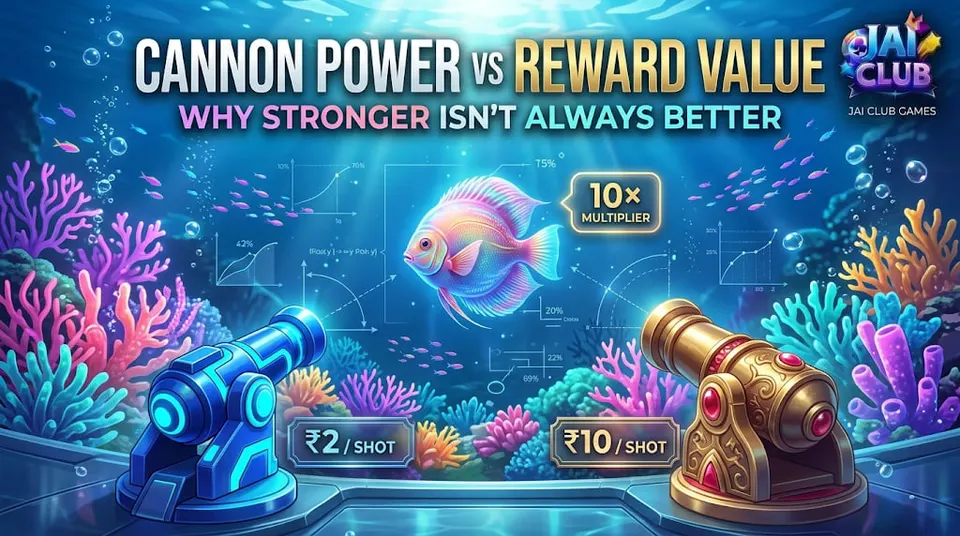
For example, a fictional game might allow shots costing ₹2, ₹5 or ₹10.
These amounts represent different stake levels.
If a user fires fifty shots costing ₹2 each, the total amount staked is:
50 × ₹2 = ₹100.
If the same number of shots costs ₹10 each, the total staked amount becomes:
50 × ₹10 = ₹500.
The number of shots is identical.
However, the total financial exposure is five times larger in the second example.
This demonstrates why cannon level can affect spending even when the visible shooting action looks nearly identical.
Why a Stronger Cannon Can Cost More
A higher cannon level may correspond to a larger stake per projectile.
That means every unsuccessful shot can consume more value.
For example, imagine a hypothetical session involving twenty shots at ₹5 each.
The total amount staked is ₹100.
Now imagine the same twenty shots at ₹20 each.
The total becomes ₹400.
The higher setting does not necessarily involve a longer session.
It simply changes the amount attached to each action.
This is especially important when shots are fired rapidly.
A higher-value cannon can increase total spending significantly without increasing the number of completed shooting actions.
The game's exact stake controls should therefore be understood separately from its visual effects.
What Is a Fish Reward Multiplier?
A fish reward multiplier describes the amount associated with a qualifying catch under the game's rules.
For example, a fictional target might carry a multiplier of 10×.
If a qualifying catch pays ten times the relevant ₹5 shot stake, the gross payout would be:
₹5 × 10 = ₹50.
At a ₹20 stake, the same hypothetical 10× multiplier would produce a gross payout of ₹200.
The higher payout reflects the larger stake.
It does not automatically establish that the higher-stake shot had a better probability of success.
The relationship between stake and catch probability depends on the game's actual mechanics.
A displayed multiplier also should not be confused with net profit across an entire session.
Why Reward Value and Profit Are Different
A successful catch can produce a visible reward while the wider session remains financially negative.
Consider a fictional example involving twenty shots at ₹5 each.
The total staked amount is ₹100.
Suppose one shot produces a qualifying catch paying a gross amount of ₹50, while the other shots return nothing.
The session has produced ₹50 in payouts against ₹100 in total stakes.
The net result is therefore a loss of ₹50.
The successful catch was genuine within the example.
However, it did not cover the total amount spent on shots.
This distinction is essential when interpreting fishing-game reward animations.
An individual payout should not be mistaken for complete session profit.
Does Increasing Cannon Power Improve Catch Probability?
There is no universal answer that applies to every fishing-shooter title.
Some games define cannon levels primarily as different stake values.
Others may incorporate additional mechanics or weapon-specific features.
The actual effect needs to be established from the particular game's instructions.
A higher cost per shot does not, by itself, prove a higher probability of catching a fish.
Likewise, a larger reward after a successful catch does not establish that the expected return has improved.
A meaningful comparison requires information about the catch probability, the amount staked and the payout associated with each possible outcome.
Without that information, claims about the best cannon level are speculative.
Why Large Fish Can Be Misleading
A large fish may appear more valuable because it occupies more space on the screen or carries a higher multiplier.
However, visual size is not a reliable measure of the probability of a successful catch.
A game's mathematical design may assign different probabilities to different target categories.
For example, a high-multiplier target could qualify less frequently than a low-multiplier target.
But the precise relationship depends on the provider.
Some games may also use special mechanics for boss creatures or bonus targets.
Therefore, the correct interpretation should come from the paytable and relevant game rules.
A large fish is not automatically an easier or more profitable target simply because it is visually prominent.
What Are Boss Fish and Special Targets?
Fishing-shooter games sometimes include larger creatures or special targets associated with additional features.
These may be presented as bosses, rare fish or event-related characters.
Depending on the title, a special target might be linked to a bonus event or a different payout calculation.
However, the term boss does not establish one universal mechanic.
Some games may require a particular qualifying event.
Others may use separate weapon functions, bonus rounds or target-specific rules.
The presence of a dramatic animation does not reveal the probability of receiving a reward.
A high advertised multiplier should be interpreted together with the relevant qualifying conditions.
Why Automatic Firing Can Change Total Spending
Some fishing games provide an auto-fire function.
This feature may continue issuing shots according to the available controls.
Its practical effect can be significant when every shot has an associated stake.
For example, suppose a hypothetical game fires two shots per second.
Over one minute, that produces 120 shots.
At ₹5 per shot, the total amount staked would be:
120 × ₹5 = ₹600.
This calculation is illustrative and assumes continuous firing for the entire minute.
It demonstrates how shot frequency and stake size interact.
Even when each individual shot appears inexpensive, a large number of repeated actions can create substantial total exposure.
Does Lock-On Targeting Guarantee a Catch?
Some arcade fishing titles include controls described as lock-on or target tracking.
These features may help direct projectiles towards a selected moving object.
However, visually accurate targeting does not necessarily guarantee a successful catch.
The game's settlement mechanism may still involve probabilities or other conditions.
A projectile appearing to contact a fish should not automatically be treated as proof that the target must award a payout.
The meaning of a hit animation can vary.
Some implementations may distinguish between visual contact, damage and a completed catch.
The relevant rules determine which event qualifies for a reward.
What Is the Difference Between Shot Accuracy and Catch Probability?
Shot accuracy concerns whether a projectile reaches the intended visual target.
Catch probability concerns whether the relevant game-defined event results in a qualifying catch.
In some games, these concepts may be related.
In others, the software may use a separate random mechanism to determine whether a target is captured.
Therefore, accurate aiming does not necessarily establish a known financial advantage.
A player might successfully direct a projectile towards a large fish without receiving the associated reward.
That does not by itself indicate an error.
It may reflect the game's documented catching mechanics.
However, any claims about a specific title should be supported by its actual rules.
Why Repeated Shots Do Not Guarantee a Reward
A common assumption is that firing at the same fish repeatedly must eventually produce a successful catch.
That depends on the game's implementation.
In a model where each shot is an independent probabilistic event, an earlier unsuccessful shot does not force the next shot to succeed.
Other implementations may maintain a form of accumulated progress or use separate target-specific conditions.
Without verified documentation, it would be incorrect to assume either arrangement universally.
The important point is that a sequence of unsuccessful shots does not automatically prove that a reward is due.
A prediction based only on how many times a fish has been targeted may have no mathematical foundation.
Understanding Fishing Game RTP
RTP stands for Return to Player.
It describes the theoretical long-run relationship between total stakes and payouts under a game's mathematical model.
Some fishing-shooter games may publish an RTP figure.
Others may provide less detailed information.
The value cannot be inferred solely from cannon power, fish size or a visible reward multiplier.
For example, a game could adjust catch probabilities and payout values while maintaining a similar theoretical return across several stake settings.
However, that relationship must be established from the actual provider's documentation.
No universal RTP percentage should be assigned to Jai Club fishing games without identifying the specific title and verified rules.
Why Higher Rewards Can Mean Greater Variability
A game may contain targets associated with modest payouts and others associated with much larger rewards.
The resulting distribution can produce substantial variation between individual sessions.
For example, a session may contain many unsuccessful shots before a high-value catch occurs.
Another session may end without reaching that result.
A larger possible payout does not necessarily mean that the underlying expected return is more favourable.
The probability of obtaining the payout is essential.
This is similar to the distinction between high multipliers and lower success probabilities in other game formats.
A reward should be evaluated using both its size and the conditions required to obtain it.
How Fishing Games Differ From Slots
Fishing-shooter games and conventional slot games have different interfaces.
A slot generally evaluates symbol combinations after a reel-based outcome.
A fishing game commonly displays moving targets and allows individual shots or targeting actions.
However, the two formats can share the concept of stakes and defined payout conditions.
In a slot, a spin may consume a specified stake.
In a fishing shooter, individual shots may consume a specified amount.
The financial exposure therefore depends on how the game counts chargeable events.
Neither format automatically provides predictable outcomes merely because its animation appears interactive.
The actual rules and payout distributions remain essential.
How Fishing Games Differ From Plinko
Plinko uses a ball-drop board with landing pockets.
Fishing games use targets, projectiles and cannon-related controls.
Both can display reward multipliers, but those multipliers describe different qualifying events.
A Plinko payout may depend on the pocket reached.
A fishing payout may depend on a target being caught under the game's rules.
Therefore, the probability model of a Plinko landing position should not be applied directly to fishing-game catches.
The two formats require separate information about result generation and settlement.
An identical multiplier, such as 10×, does not establish equal probabilities or equivalent expected returns.
Why Game Histories Are Not Catch Predictions
Some gaming interfaces maintain records of previous activity.
A fishing-game history might show completed catches or account transactions, depending on the title.
However, a previous high-value catch does not automatically reveal when another will occur.
Likewise, a sequence of missed shots cannot establish that the next shot must succeed.
A reliable prediction claim would require evidence that the game's outcome mechanism creates a predictable relationship between events.
A short record of previous activity is insufficient.
Visual patterns, target movement and repeated cannon levels should not be treated as guaranteed indicators of future rewards.
What Should Be Checked in a Fishing Game's Rules?
A useful game description should explain what each shot costs and how the cost changes between cannon settings.
It should also identify how rewards are calculated and what qualifies as a successful catch.
If the game contains special weapons, bosses or bonus features, their rules should be described separately.
A published RTP or other probability information may provide further context where available.
Without these details, comparing cannon levels based only on appearance can be misleading.
For educational information about other arcade and multiplier formats, explore the Jai Club Games overview and the blog archive.
Actual fishing-game availability must be verified from the relevant service.
Frequently Asked Questions
What does cannon power mean in fishing games?
It commonly describes a weapon or shot setting. In some titles, higher levels increase the stake per shot, while exact mechanics vary by provider.
Does a stronger cannon guarantee catching more fish?
No universal rule establishes that. The actual result depends on the game's documented mechanics.
What is a fishing-game reward multiplier?
It is a game-defined factor used to calculate a qualifying payout according to the relevant stake and settlement rules.
Why can a larger cannon produce a larger payout?
A higher stake per shot can produce a larger currency payout when the same total-return multiplier applies.
Does a larger fish always have a higher catch probability?
No. Visual size does not independently establish the probability of a qualifying catch.
Does auto-fire increase spending?
It can, when each automatically fired shot consumes a stake. Total spending depends on shot count and stake per shot.
Can repeated missed shots guarantee the next catch?
Not under an independent per-shot probability model. Actual behaviour depends on the provider's documented rules.
Is fishing-game RTP determined by cannon size?
Not necessarily. RTP depends on the game's complete probability and payout structure.
Are these verified Jai Club fishing-game payout rules?
No. They describe common fishing-shooter mechanics and illustrative calculations. A particular game's rules must be checked independently.
Conclusion
Fishing-game cannon power and reward value are related concepts, but they are not identical.
A higher cannon level may increase the stake attached to each shot. A higher fish multiplier may increase the payout associated with a qualifying catch.
However, neither change automatically establishes a better catch probability or expected financial return.
The overall result depends on shot costs, payout conditions, catch probabilities and any special features defined by the game.
A visually stronger weapon should therefore not be confused with a guaranteed advantage.
For more educational guides about arcade, slot and number-based game formats, explore the Jai Club Game information hub.
Understanding the difference between stake size and reward value provides a more accurate interpretation of fishing games than relying on cannon appearance or previous catch animations.