
Limbo 2× vs 5×: Why a Higher Target Is Harder to Reach
Compare Limbo 2x vs 5x multiplier targets. Learn how target selection, win probability, RTP, result settlement and house edge differ from crash games such as Aviator.
In this article
- What Is the Jai Club Limbo Game?
- Understanding the Target Multiplier
- Why 5× Is Harder to Reach Than 2×
- How Limbo Win Probability Is Calculated
- Limbo 2× Probability Explained
- Limbo 5× Probability Explained
- Comparing the Two Targets With ₹100
- Why the Expected Return Can Be the Same
- RTP vs Win Frequency
- What Is the House Edge?
- Limbo vs Aviator: What's the Difference?
- Does a Limbo Round Have a Countdown?
- Why 10× Is Not Simply Twice as Good as 5×
- What Does a Generated Limbo Result Represent?
- Can Previous Limbo Results Predict the Next One?
- Why Provider Rules Still Matter
- Frequently Asked Questions
- What is the Jai Club Limbo game?
- Is a 2× target more likely than 5×?
- What is the probability of 2× in Limbo?
- What is the probability of 5× in Limbo?
- Does a higher target improve RTP?
- Is Limbo the same as Aviator?
- Can Limbo results be predicted from history?
- Does a 5× payout mean five times the profit?
- Conclusion
A Limbo game displays a target multiplier before a round begins. One person may choose 2×, while another selects 5×. Both see a numerical result, but their selected targets lead to different settlement conditions.
The difference seems straightforward. A 5× target offers a larger possible payout than a 2× target.
However, a higher target is normally harder to reach.
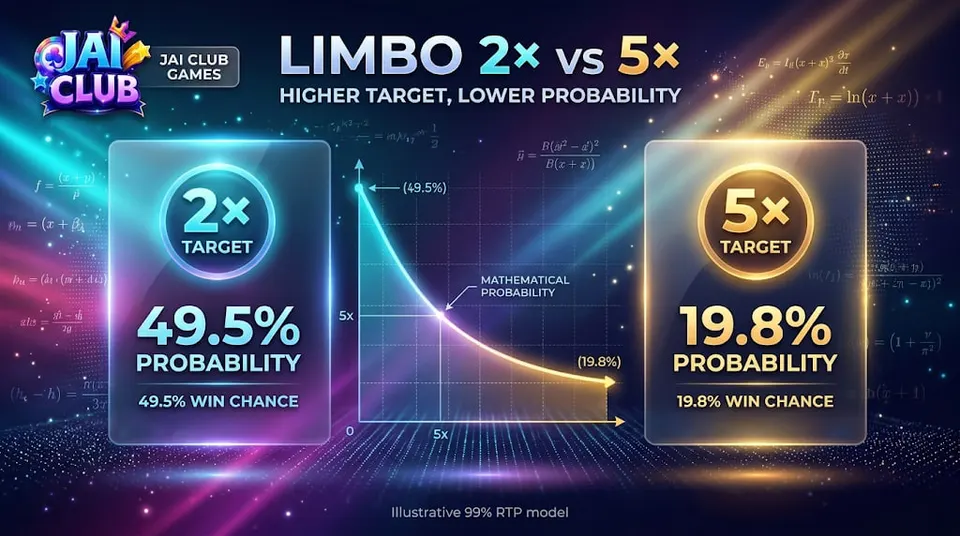
In a commonly used Limbo probability model with a 99% theoretical return, a 2× target has a 49.5% chance of success, while a 5× target has a 19.8% chance.
These figures demonstrate the relationship between probability and payout size. They should not be treated as verified figures for every Jai Club Limbo game implementation.
For readers researching Jai Club Limbo game rules, the important questions concern how the result is generated, how the target is compared with the result and whether the advertised multiplier represents a total return.
This guide explains these mechanics and why a larger multiplier does not automatically produce a better expected financial outcome.
What Is the Jai Club Limbo Game?
Limbo is a multiplier-based game format commonly associated with online gaming catalogues.
Its defining feature is the relationship between a target multiplier and a generated result.
In a common implementation, the target is specified before the round is settled.
The game then produces a numerical multiplier.
If the generated result meets or exceeds the target under the game's rules, the relevant outcome qualifies.
If the result is below the selected target, the condition is not satisfied.
This differs from a conventional number lottery because the primary comparison involves a multiplier threshold rather than one digit or a dice sum.
The exact range of available targets, rounding method and settlement rules depend on the provider.
Understanding the Target Multiplier
A target multiplier defines the threshold that a generated result must reach.
Consider a fictional Limbo round with a selected target of 2.00×.
If the game's generated result is 3.60×, it exceeds the selected target.
Under the commonly described rules, the 2.00× condition is satisfied.
Now suppose the selected target was 5.00× instead.
The same generated result of 3.60× would not satisfy the higher target.
The result has not changed.
What changed is the condition being evaluated.
This is why two different targets can produce different settlement outcomes when compared against the same generated coefficient.
Why 5× Is Harder to Reach Than 2×
A higher threshold is more restrictive.
Every numerical result that reaches 5× also reaches 2×.
However, many results that reach 2× do not reach 5×.
For example, a result of 2.80× satisfies a 2× threshold but not a 5× threshold.
Likewise, a result of 4.90× remains below 5× even though it exceeds 2×.
This is a mathematical relationship between nested events.
The event of reaching at least 5× is a subset of the event of reaching at least 2×.
Therefore, under any consistent distribution of generated multipliers, reaching 5× cannot be more probable than reaching 2×.
The exact difference depends on the game's probability model.
How Limbo Win Probability Is Calculated
Some Limbo implementations use a theoretical return-to-player model in which the approximate probability of reaching a target is calculated by dividing the RTP factor by the target multiplier.
For example, with a 99% theoretical RTP, the simplified relationship is:
Win probability = 0.99 ÷ target multiplier.
For a 2× target:
0.99 ÷ 2 = 0.495.
This corresponds to 49.5%.
For a 5× target:
0.99 ÷ 5 = 0.198.
This corresponds to 19.8%.
The formula illustrates a commonly documented model, including the one described in Stake's Limbo guide.
It is not a universal rule for every provider, especially where rounding, limits or different payout mechanisms apply.
Limbo 2× Probability Explained
A 2× target is associated with a total-return multiplier of two times the stake when the qualifying condition is satisfied.
Under the illustrative 99% RTP model, the probability of reaching this target is 49.5%.
The remaining 50.5% represents outcomes that fail to meet the threshold.
That means a 2× target is not guaranteed to succeed on every second round.
The 49.5% figure describes the probability of the defined event over the mathematical model.
Short sequences can produce more or fewer successes than expected.
A few favourable results also do not establish that future outcomes will follow a predictable pattern.
The actual financial return depends on the stake and the settlement terms.
Limbo 5× Probability Explained
A 5× target requires a higher generated coefficient.
Under the same illustrative 99% RTP model, its probability is 19.8%.
That is less than one-fifth of all possible rounds on average under the model.
However, the result of an individual round remains uncertain.
A 19.8% probability does not mean success is guaranteed after five attempts.
Several unsuccessful rounds can occur consecutively.
Similarly, a qualifying result can occur sooner than expected.
Probability describes the distribution of possible events, not a timetable requiring outcomes to appear at regular intervals.
This is why interpreting a percentage as a countdown to the next successful result is incorrect.
Comparing the Two Targets With ₹100
Consider a hypothetical ₹100 stake.
At a 2× total-return multiplier, a qualifying result returns ₹200.
The net gain from that individual successful event is ₹100 after subtracting the original stake.
At a 5× total-return multiplier, a qualifying result returns ₹500.
The net gain from that event is ₹400.
The larger 5× payout is attractive when viewed in isolation.
However, the lower probability of reaching 5× must also be considered.
A larger payout does not automatically establish a better expected return.
The appropriate calculation combines the probability of success with the credited amount.
Why the Expected Return Can Be the Same
Using the hypothetical 99% RTP model, the expected gross payout can be calculated for both targets.
At 2×, the chance of success is 49.5%.
Multiplying 0.495 by a ₹200 qualifying payout gives ₹99.
At 5×, the chance of success is 19.8%.
Multiplying 0.198 by a ₹500 qualifying payout also gives ₹99.
In both cases, the expected gross return is ₹99 for a ₹100 stake under the simplified model.
The expected net result is therefore a loss of ₹1 per ₹100 staked.
This illustrates why changing the target multiplier does not necessarily improve the long-run mathematical expectation.
The outcomes become more variable, but the theoretical return can remain the same.
RTP vs Win Frequency
Return to Player, or RTP, describes a theoretical long-run relationship between total stakes and payouts.
Win frequency describes how often a defined qualifying event occurs.
These concepts are related but different.
A lower target multiplier may have a higher frequency of qualifying outcomes.
A higher target may succeed less frequently but produce a larger payout when it does.
Both configurations can still have the same theoretical RTP if the game adjusts their probabilities appropriately.
Therefore, a higher win frequency is not automatically evidence of a more favourable financial expectation.
The actual payout formula and provider margin must be considered.
What Is the House Edge?
The house edge is the difference between the theoretical stake amount and the expected payout, expressed as a proportion of the stake.
For example, a theoretical RTP of 99% corresponds to a 1% house edge under a conventional interpretation.
That means the game is designed to return an average of ₹99 per ₹100 staked across a sufficiently large theoretical sample.
It does not mean an individual session will lose exactly ₹1.
Actual short-term outcomes can vary substantially.
A user might experience several successful results or a sequence of unsuccessful rounds.
The theoretical house edge describes an expectation, not a guaranteed result for one account.
Limbo vs Aviator: What's the Difference?
Limbo and Aviator both involve multipliers, but their usual interaction structures differ.
Limbo commonly requires the target to be specified before a generated result is evaluated.
Aviator-style crash games typically display a multiplier rising during an active shared round.
In a crash game, the round can terminate before a particular coefficient is reached.
In Limbo, the primary comparison may be between a preselected threshold and a separately generated result.
Both can use multiplier notation, but the interface timing and settlement events are different.
A 2× Limbo result should therefore not automatically be interpreted as equivalent to an Aviator cash-out at 2×.
Does a Limbo Round Have a Countdown?
The timing structure depends on the version.
Some Limbo formats provide an immediate result after the relevant action.
Crash-style games may instead include a waiting phase followed by an active multiplier animation.
A brief Limbo animation does not necessarily mean the outcome was determined through the same mechanism as a crash endpoint.
Likewise, a visually rising result display does not establish that users can change the target after the round has begun.
The exact permitted interactions must be confirmed from the game rules.
The essential difference is that Limbo commonly evaluates a predefined target against a generated numerical result.
Why 10× Is Not Simply Twice as Good as 5×
A 10× target offers twice the total-return multiplier of a 5× target.
However, it is generally harder to achieve.
Under the same simplified 99% RTP model, a 10× target has a 9.9% theoretical success probability.
The 5× target has a 19.8% probability.
Thus, the 10× target offers a payout twice as large but succeeds half as often under this model.
The expected return remains the same.
This illustrates why the size of a displayed multiplier should not be evaluated independently from the probability associated with it.
The same principle applies to many other game formats that offer different reward multipliers for different outcomes.
What Does a Generated Limbo Result Represent?
The generated result is a numerical output defined by the game's mechanism.
It is not necessarily an account balance, a profit figure or a period identifier.
For example, a result of 3.45× should be understood as a coefficient.
It should not be interpreted as the digit 3 in WinGo or as a K3 sum.
Similarly, a target multiplier of 5× describes a condition selected before the round, not a guarantee that the generated result will reach five.
The distinction between target and result is essential.
A complete history should make it possible to identify which value was selected and which value was generated.
Can Previous Limbo Results Predict the Next One?
A result history can show previously generated coefficients.
However, a sequence of earlier results does not automatically reveal future outcomes.
For example, several results below 2× do not mathematically require a 5× result to appear next.
Likewise, a recent high coefficient does not prove that the following round will be low.
If a game uses independent outcome generation, each new round follows the same underlying distribution regardless of the previous sequence.
Reliable prediction claims would require evidence about the actual mechanism rather than selected screenshots.
A history chart describes completed events; it does not provide a guaranteed forecast.
Why Provider Rules Still Matter
The probability examples in this guide use a specific simplified mathematical model.
Actual Limbo games may differ in RTP, rounding, maximum multiplier, minimum target or settlement conditions.
Some systems round generated results to two decimal places.
Other implementations may define different treatment at exact boundaries.
For instance, a rule using greater than or equal to a target is not mathematically identical to one using strictly greater than when discrete rounded outcomes are possible.
The provider's published documentation determines the actual interpretation.
No universal percentage should be assigned to Jai Club Limbo without identifying the specific version and its mathematical rules.
Frequently Asked Questions
What is the Jai Club Limbo game?
Limbo is a multiplier-based format in which a generated result is commonly compared with a target selected before the round.
Is a 2× target more likely than 5×?
Yes, in conventional threshold-based Limbo mechanics, because reaching 5× also satisfies the lower 2× threshold.
What is the probability of 2× in Limbo?
Under an illustrative model with 99% RTP, it is approximately 49.5%.
What is the probability of 5× in Limbo?
Under the same model, it is approximately 19.8%.
Does a higher target improve RTP?
Not necessarily. A game can maintain the same theoretical RTP across different targets.
Is Limbo the same as Aviator?
No. Limbo commonly evaluates a preselected target, while Aviator uses an active crash multiplier.
Can Limbo results be predicted from history?
Previous results alone do not establish a reliable method of predicting future independently generated outcomes.
Does a 5× payout mean five times the profit?
Not when 5× is defined as total return. On a ₹100 stake, a ₹500 gross payout represents ₹400 net gain for that event.
Conclusion
Limbo demonstrates why a larger potential payout must be understood together with its probability.
A 2× target is easier to reach than a 5× target under conventional multiplier-threshold mechanics.
In an illustrative 99% RTP model, the respective success probabilities are 49.5% and 19.8%.
Although the larger target offers a greater payout when its conditions are satisfied, the theoretical expected return can remain unchanged.
For broader information about multiplier-based games, crash games and related formats, explore the Jai Club Games overview.
The target multiplier describes the condition being evaluated. It does not establish that the next result will reach that value.