One Result, Three Records: What a Jai Club Game Screen Can Show
One Jai Club game round may appear differently in the live result screen, game history and wallet transaction records. Learn what each record means and why the information may update at different times.
In this article
- One Result, Three Records: What a Jai Club Game Screen Can Show
- What Are the Three Records of a Gaming Round?
- 1. Live Game Result: What Happened in the Round?
- Example of a WinGo Live Result
- 2. Result History: Which Round Produced the Outcome?
- Why Period Identifiers Matter
- 3. Wallet Records: Was There an Account Transaction?
- Why a Wallet Entry May Show a Different Number
- Live Result vs History vs Wallet: Comparison
- Why Can the Three Records Update at Different Times?
- Example Timeline
- Does a Missing History Entry Mean the Result Was Cancelled?
- What If the Game Result and Wallet Amount Disagree?
- A Wallet Balance Is Not the Same as a Settled Transaction
- Why Do Slot and Crash Games Have Different Result Records?
- What Can a Screenshot Prove About a Result?
- How to Check an Apparent Result Discrepancy
- Step 1: Identify the Game Format
- Step 2: Match the Round Identifier
- Step 3: Identify the Information Type
- Step 4: Review the Published Rules
- Step 5: Review Transaction Status
- Step 6: Keep Relevant Evidence
- Step 7: Use Verified Support
- Can Previous Result Records Predict Future Results?
- Frequently Asked Questions
- Why does my Jai Club game result differ from the history screen?
- Is the live result the same as the wallet transaction?
- Why does a new round start before the previous result appears?
- Does a completed result mean money was credited?
- Can a wallet credit prove a bank withdrawal succeeded?
- What information should be saved if a result appears wrong?
- Can screenshots verify official result records?
- Conclusion
One Result, Three Records: What a Jai Club Game Screen Can Show
A game finishes and the screen displays a result. A few seconds later, the same round appears in the result history. Meanwhile, the account wallet may show a separate transaction entry.
All three records can relate to the same gaming event, but they answer different questions.
The live result tells you what happened, the history identifies the completed round, and the wallet record may explain the financial settlement associated with an account.
Confusing these records can create unnecessary concern when information appears at different times or uses different labels.
For anyone researching Jai Club game results, understanding these differences is useful because number games, crash-style games and slot interfaces may present outcomes in several places.
This article explains the three records commonly encountered in gaming interfaces, how they relate to one another and what to check when the displayed information appears inconsistent.
The examples describe general account and game-record systems. They do not imply that every Jai Club service provides all three records or uses identical settlement procedures.
What Are the Three Records of a Gaming Round?
A gaming platform may contain several separate information sections.
Three particularly important ones are:
- Live game result
- Completed result history
- Account or wallet transaction record
Each section serves a different purpose.
The live screen focuses on the current gameplay event.
The history provides information about completed events.
The account record focuses on financial entries associated with a particular account, where such a feature exists.
These distinctions are important when checking whether a number, payout or period has been recorded correctly.
1. Live Game Result: What Happened in the Round?
The live result is the outcome presented during or immediately after a game round.
In WinGo, it may be a digit between 0 and 9.
In K3, it may contain three dice and their combined sum.
In 5D, it may display five numerical positions.
In a slot game, the result usually involves symbols arranged on reels.
In a crash-style game, the completed result may be represented by a final multiplier.
The form differs, but the purpose is similar: it communicates the outcome of a specific gameplay event.
Example of a WinGo Live Result
Consider this fictional result:
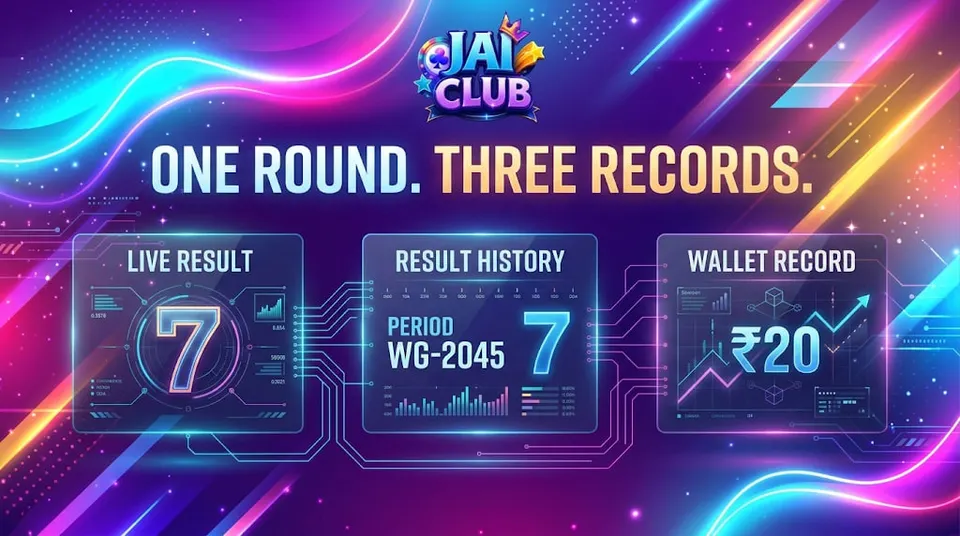
Period: WG-2045
Number: 7
Size: Big
Colour association: Green
The result describes one completed numerical outcome under a commonly used WinGo classification.
It does not automatically establish the financial settlement of every account participating in the round.
A user may have selected a different category, or the game may apply additional rules.
The displayed number and the credited amount are therefore different pieces of information.
2. Result History: Which Round Produced the Outcome?
A history section generally stores or displays information about previously completed rounds.
Its purpose is to provide a record that can be associated with a particular event.
For timed number games, this commonly involves a period identifier and numerical outcome.
For other formats, a history may show multipliers, symbols or other result information.
A history record can be especially useful when a new countdown begins before the previous completed result becomes visible.
Why Period Identifiers Matter
Consider two fictional records:
| Period | Result |
|---|---|
| WG-2045 | 7 |
| WG-2046 | 2 |
These are two separate rounds.
The second result does not replace the historical fact that the first period ended with 7.
An interface might already be displaying the countdown for the following period while its results area still shows the previous completed outcome.
Without checking the identifier, a user may incorrectly conclude that the results conflict.
Our article on why WinGo result history sometimes updates late explains the distinction between completed results and delayed interface updates.
3. Wallet Records: Was There an Account Transaction?
A wallet or transaction section may record financial activity associated with an account.
It can contain entries such as stakes, credits, refunds, reversals or withdrawal requests, depending on the service.
Unlike a general result history, an account ledger is usually specific to the account holder.
A result may be common to every participant in a round, while the financial consequences differ according to individual account activity and settlement rules.
For example, a game round might produce the number 7.
That same public result does not mean every account receives an identical credit.
The wallet record must be interpreted using the applicable transaction type and account-specific details.
Why a Wallet Entry May Show a Different Number
Suppose a fictional game result is 7 and an account transaction displays ₹20.
These values are not contradictory.
The number 7 represents the outcome.
The ₹20 amount represents a financial entry.
They describe different aspects of the same or related activity.
A common mistake is expecting every field in the live interface, history and wallet to contain matching numerical values.
They are not supposed to match unless they describe the same measurement.
Live Result vs History vs Wallet: Comparison
| Feature | Live Result | Result History | Wallet Record |
|---|---|---|---|
| Main purpose | Show game outcome | Record completed events | Record account activity |
| Common identifier | Round or period | Period and result | Transaction reference |
| Typical information | Number, symbols or multiplier | Previous outcomes | Amount and status |
| Account-specific? | Often shared | Often shared | Usually |
| May update separately? | Yes | Yes | Yes |
| Proves a bank transfer? | No | No | No |
A wallet credit is not automatically proof that money has arrived in a bank account.
Similarly, a completed result is not automatically proof of a successful withdrawal.
Each type of record needs to be interpreted according to its own purpose.
Why Can the Three Records Update at Different Times?
A gaming interface may communicate with different services or processing components.
For example, a completed result might be generated and recorded before every connected screen refreshes.
A history page may update after the completed event is available.
A financial ledger may have additional processing steps before an entry becomes final.
The exact technical architecture depends on the operator.
However, the general principle is that display timing and underlying record timing are not necessarily identical.
Example Timeline
Consider a hypothetical round.
| Time | Example Event |
|---|---|
| 12:00:00 | Round closes |
| 12:00:01 | Result becomes available |
| 12:00:03 | History display refreshes |
| 12:00:05 | Related wallet entry appears |
This is an illustrative timeline, not a verified description of Jai Club processing.
It shows why a short delay between separate screens does not by itself establish that an outcome has changed.
A persistent discrepancy, however, should be investigated using actual records.
Does a Missing History Entry Mean the Result Was Cancelled?
Not necessarily.
A missing entry can have several possible explanations.
The interface may not have refreshed.
The wrong period may be selected.
A browser may display an outdated version of the page.
The relevant results endpoint may also be temporarily unavailable.
However, users should not assume that all missing entries are harmless.
If an expected record remains absent, the correct response is to compare the official result information, period identifier and any available transaction reference.
Avoid relying on screenshots from unrelated messaging groups as the sole evidence.
What If the Game Result and Wallet Amount Disagree?
A result and a wallet amount are different quantities, but a genuine settlement disagreement can still occur.
For example, a completed outcome might appear to qualify under the published rules, while the account shows a different credited amount.
Before drawing a conclusion, identify:
- The correct round identifier
- The exact selection recorded by the account
- The stake, if applicable
- The completed result
- Any special settlement conditions
- The transaction reference and status
Different selection types may have different payment rules.
A partial payout, deduction or reversal should not be assumed unless the provider's actual records explain it.
If the discrepancy remains unresolved, preserve the relevant details and contact a verified support channel.
A Wallet Balance Is Not the Same as a Settled Transaction
Another source of confusion is the difference between the total wallet balance and individual transaction entries.
A balance is a snapshot or calculated total.
A transaction entry describes a particular change or event.
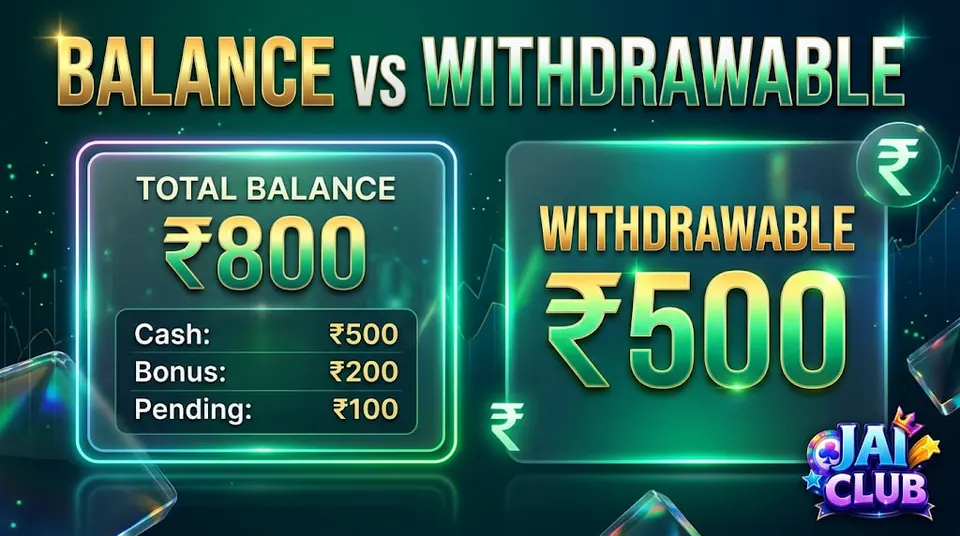
For example, a wallet might display ₹800 while its withdrawal section shows only ₹500 eligible.
Those values may represent different account categories.
Our detailed article on Jai Club game balance versus withdrawable balance discusses the general distinction between recorded funds, promotional credits and withdrawable amounts.
Understanding that difference prevents a completed game result from being confused with unrestricted cash.
Why Do Slot and Crash Games Have Different Result Records?
Number games commonly use scheduled periods.
Slots usually organise activity around spins.
Crash games commonly organise activity around active rounds and completed multipliers.
Therefore, their result histories may differ.
A slot history might identify individual spins and credited payouts.
A crash history might display completed multiplier endpoints.
A WinGo history may list period numbers and numerical outcomes.
These are different record structures.
A multiplier should not be read as a period identifier, and a slot payout should not be mistaken for a draw number.
For a comparison of result types, see how numbers have different meanings across Jai Club games.
What Can a Screenshot Prove About a Result?
A screenshot can capture what a screen displayed at a particular moment.
It may include a game name, period identifier, numerical result or transaction status.
However, a screenshot alone cannot verify the underlying system record.
It may be incomplete, outdated or altered.
Even an authentic screenshot can omit the information needed to understand a transaction.
A screenshot of a result is therefore not equivalent to a complete account statement.
Our related article, what a Jai Club game screenshot can actually prove, examines these limitations in detail.
How to Check an Apparent Result Discrepancy
A careful comparison is more useful than immediately assuming the result is incorrect.
Step 1: Identify the Game Format
Determine whether the record relates to WinGo, K3, 5D, a slot or a crash-style game.
Step 2: Match the Round Identifier
Ensure that the live result and history entry refer to the same completed event.
Step 3: Identify the Information Type
Separate the result number, selection, stake, payout and wallet balance.
Step 4: Review the Published Rules
Check how qualifying outcomes are defined and whether special conditions apply.
Step 5: Review Transaction Status
Distinguish pending, completed, rejected and reversed entries when those statuses are available.
Step 6: Keep Relevant Evidence
Save the period identifier, transaction reference, time and error message without exposing sensitive credentials.
Step 7: Use Verified Support
If the records remain inconsistent, request clarification from an independently verified provider.
Can Previous Result Records Predict Future Results?
History records describe completed outcomes.
They do not automatically reveal future results.
For example, a sequence of Big results in WinGo does not establish that Small must appear next.
Similarly, previous crash multipliers do not guarantee a future multiplier.
Historical records can be useful for understanding what happened, but prediction claims require evidence about the actual outcome-generation process.
A result history is not a reliable forecasting tool merely because it contains many entries.
Frequently Asked Questions
Why does my Jai Club game result differ from the history screen?
Possible explanations include comparing different periods, delayed updates or a genuine discrepancy. Match the round identifiers before concluding that the records conflict.
Is the live result the same as the wallet transaction?
No. The result records the gameplay outcome, while the wallet entry may record related financial activity.
Why does a new round start before the previous result appears?
Result availability and interface refresh timing can differ. Check the completed period identifier.
Does a completed result mean money was credited?
Not automatically. Financial settlement depends on account activity and the applicable rules.
Can a wallet credit prove a bank withdrawal succeeded?
No. A wallet entry is not independent confirmation of funds received by a bank.
What information should be saved if a result appears wrong?
Keep the period identifier, completed result, relevant account transaction reference, date and any visible error message.
Can screenshots verify official result records?
Screenshots can support a report but do not independently establish the authenticity of underlying records.
Conclusion
A Jai Club game screen may present several records associated with one event.
The live result describes the outcome. The history links completed results to their rounds. The wallet may record account-specific financial activity.
These records are related, but they do not necessarily contain identical information or refresh simultaneously.
For a broader explanation of the different game formats and account features, explore the Jai Club Game overview.
The most useful question is not whether three screens display the same number, but whether each record accurately describes its own part of the event.