Jai Club Lottery Results: What Does TRX WinGo Actually Verify?
What does TRX mean in Jai Club Lottery? Explore TRX WinGo, blockchain transaction references, result periods and why a visible hash does not automatically prove that every game result is fair.
In this article
- What Does Jai Club Lottery Refer To?
- What Is TRX?
- What Is a Blockchain Transaction Hash?
- A Transaction Hash Is Not the Same as a WinGo Result
- What Would Real Result Verification Require?
- TRX WinGo vs Ordinary WinGo
- What Is a Lottery Period Number?
- Can TRONSCAN Verify a TRX WinGo Result?
- What Does Provably Fair Actually Mean?
- Why the TRX Label Does Not Guarantee Prediction
- How K3 and 5D Differ From TRX WinGo
- Can a Result History Prove the Game Is Fair?
- Why a Blockchain Reference Can Be Misleading
- How to Interpret a TRX WinGo Information Page
- Why This Matters for Jai Club Game Research
- Frequently Asked Questions
- What does TRX mean in TRX WinGo?
- Is TRX WinGo the same as ordinary WinGo?
- Can TRONSCAN verify a transaction hash?
- Does a verified transaction prove a game result is fair?
- Is a lottery period number a transaction hash?
- Can TRX WinGo results be predicted from old hashes?
- Does blockchain verification guarantee withdrawals?
- Are K3 and 5D blockchain games?
- Conclusion
Jai Club Lottery searches frequently bring together names such as WinGo, TRX WinGo, K3 and 5D. At first glance, these games may appear similar because they use numerical results, timed rounds and history screens.
However, the label TRX introduces an additional question.
Does TRX WinGo actually use blockchain information to determine its results, and can those results be independently verified?
The presence of the word TRX does not, by itself, answer either question.
TRX is associated with the TRON blockchain ecosystem. A gaming website may use the term when describing a blockchain-related result process, but the actual connection between a transaction and a game result needs to be established through verifiable rules.
This article explains the difference between a lottery result, a period identifier, a blockchain transaction hash and a mathematical transformation used to produce a game outcome.
Rather than repeating basic WinGo colour rules, the focus is on what different pieces of evidence can demonstrate.
What Does Jai Club Lottery Refer To?
Jai Club Lottery is a search phrase associated with number-based gaming formats discussed on Jai Club-related websites.
These formats commonly include WinGo, K3 and 5D.
Some websites also describe TRX WinGo as a variation that refers to blockchain information.
The formats share certain interface characteristics.
They may display numbered periods, countdowns, completed results and historical records.
However, their outcome structures differ.
A common WinGo result contains one digit between 0 and 9.
K3 commonly uses three dice, while 5D represents results through five numerical positions.
TRX WinGo raises a different issue because the name suggests a connection with external blockchain data.
That claim needs to be examined separately from the ordinary result display.
What Is TRX?
TRX is the native cryptocurrency of the TRON blockchain network.
The TRON network maintains records of blockchain activity, including transactions and blocks.
Public blockchain explorers can display certain information associated with those records.
For example, a verified transaction record may include a transaction identifier, block association, timestamp and confirmation status.
These are blockchain records.
They are not automatically lottery results.
A gaming service that uses the letters TRX in its title does not necessarily prove that every round is generated or settled on the TRON blockchain.
The relationship needs to be explained and verifiable.
What Is a Blockchain Transaction Hash?
A transaction hash is a unique-looking identifier associated with a blockchain transaction.
On TRON, a transaction identifier can be used to look up information through a blockchain explorer such as TRONSCAN.
The explorer may show whether the transaction exists and provide relevant details about its recorded status.
That is useful evidence for establishing the existence of a particular blockchain transaction.
However, the transaction hash does not automatically explain how a separate gaming application calculates a WinGo number.
For example, a blockchain transaction identifier may contain a long string of hexadecimal characters.
A WinGo result commonly contains one digit.
Some transformation would be needed if an application claims to derive the single digit from the transaction data.
The transformation is a separate rule that needs to be known.
A Transaction Hash Is Not the Same as a WinGo Result
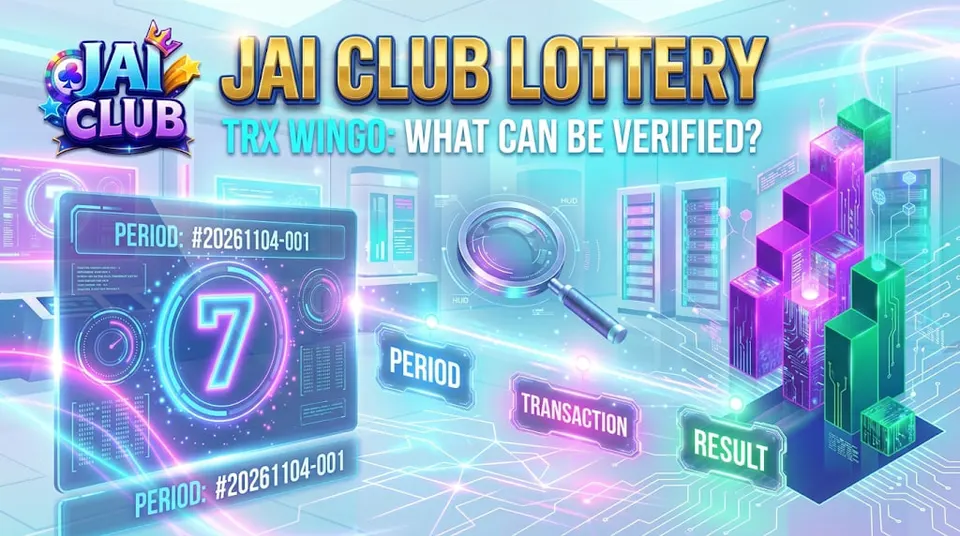
Imagine a fictional gaming page displaying a completed result of 7 alongside a long transaction identifier.
The presence of both values does not automatically establish that the number 7 was generated from the identifier.
Several questions remain.
Which transaction was selected? Was it chosen before the round ended? Which part of the transaction data is used? How is that data converted into the final digit?
Without answers, the displayed relationship cannot be independently checked.
The distinction is between showing two pieces of information together and demonstrating a reproducible connection between them.
A transaction may be genuine while a claim about how it was used remains unverified.
What Would Real Result Verification Require?
Meaningful verification involves more than finding a transaction in a blockchain explorer.
A service claiming to derive results from blockchain information should provide a clearly defined method.
The method needs to identify the source data and explain how a particular round is connected to that data.
It should also describe the mathematical rule used to convert the selected information into the result.
An independent reader should be able to repeat the calculation and obtain the same output.
For example, if a result is supposedly based on specific characters within a transaction hash, the exact selection rule needs to be published.
If the method changes between rounds without explanation, independent reproduction becomes difficult.
Similarly, if the application selects its source transaction only after seeing the available data, the process may introduce additional concerns about selection bias.
These issues are separate from whether the blockchain transaction itself is genuine.
TRX WinGo vs Ordinary WinGo
Ordinary WinGo and TRX WinGo may share similar visual elements.
Both can display a countdown, result digit and history records.
However, the presence of TRX in the name creates a claim or suggestion about the source of results that ordinary WinGo does not necessarily make.
The exact mechanics depend on the implementation.
A website might describe TRX WinGo as blockchain-related without publishing the actual result-generation algorithm.
Another service could provide more detailed documentation.
The name alone cannot establish which situation applies.
Therefore, a meaningful comparison needs to examine the published rule for obtaining the result, not merely the colour of the buttons or the length of the countdown.
What Is a Lottery Period Number?
A period number identifies a particular game round or draw.
It can help connect a completed result to the event it belongs to.
For example, a fictional interface might use the identifier TW-2045.
The label identifies the round.
It does not, by itself, prove that the result came from blockchain activity.
A period identifier is also not the same thing as a transaction hash.
The former belongs to the gaming service's round-record system.
The latter identifies a blockchain transaction.
A provider might publish a method connecting the two, but that relationship must be demonstrated.
A long string of digits should not be mistaken for blockchain verification simply because it looks technical.
Can TRONSCAN Verify a TRX WinGo Result?
TRONSCAN can be used to inspect information recorded on the TRON blockchain.
Its documentation describes transaction lookup using a transaction hash.
However, confirming that a transaction exists is only part of a broader verification question.
A blockchain explorer does not automatically know the rules of an unrelated gaming platform.
It cannot determine whether the platform selected the correct transaction for a round unless the relevant relationship is defined.
It also cannot determine whether an unpublished algorithm correctly converts the blockchain data into the displayed WinGo result.
For these reasons, a valid transaction record and a verifiable game result are not identical claims.
Readers can learn about blockchain transaction records through the public TRONSCAN explorer.
The explorer is a blockchain information service, not an endorsement of any particular gaming platform.
What Does Provably Fair Actually Mean?
The phrase provably fair is often associated with systems that provide methods for independently checking outcomes.
However, the phrase should describe an actual verification process rather than serve as an unsupported marketing claim.
A meaningful method needs to explain where the result data comes from and how the result is calculated.
It should also provide sufficient information for an independent party to reproduce the calculation.
Even then, verifying a particular result-generation process does not automatically establish that every other aspect of the platform is trustworthy.
Account security, payment processing, withdrawal conditions and software authenticity are separate matters.
A valid mathematical result does not prove that an unrelated financial transaction was completed.
Why the TRX Label Does Not Guarantee Prediction
Some people may assume that a blockchain-related game is easier to predict because blockchain data is publicly visible.
That reasoning overlooks an important distinction.
Publicly verifiable information can help confirm an event after it has occurred.
It does not necessarily reveal an unknown future result.
If a game genuinely uses future blockchain data that has not yet been produced, the future value may remain unknown until the relevant event occurs.
Historical transaction patterns also do not automatically provide a reliable method for predicting an independently generated future outcome.
A claim that a public blockchain guarantees predictable WinGo numbers requires evidence about the actual process.
The presence of transaction histories does not establish such a guarantee.
How K3 and 5D Differ From TRX WinGo
K3 and 5D are generally described according to their result formats.
K3 focuses on three dice and their combined totals.
5D uses five numerical positions.
TRX WinGo, by contrast, introduces a question about an alleged external source of randomness or result data.
These are different kinds of distinctions.
One concerns the structure of the outcome.
The other concerns where the outcome may come from.
A game can use a numerical result format without using blockchain information.
Likewise, a platform could theoretically use external data to generate results in more than one game format.
The specific rules determine whether that relationship exists.
Can a Result History Prove the Game Is Fair?
A history screen can document previously displayed outcomes.
For example, it may show several period identifiers and their associated results.
However, a record of outputs does not automatically establish how those outputs were generated.
An application might display hundreds of completed numbers without providing a verifiable explanation of the result-generation process.
The history may still be useful for checking which result belonged to which period.
But fairness claims require additional information about the underlying mechanism.
This distinction applies to WinGo, TRX WinGo, K3 and 5D.
A well-organised history table is not a substitute for independent verification.
Why a Blockchain Reference Can Be Misleading
Technical terms can create an impression of credibility.
Words such as blockchain, hash, transaction and smart contract may sound reassuring to readers.
However, their actual meaning depends on how they are used.
A valid blockchain transaction can exist independently from a gaming application.
Displaying its identifier on a website does not prove that the application used it correctly.
Similarly, a numerical value claimed to be blockchain-derived may require a separate transformation rule that has not been published.
Therefore, technical terminology should be treated as a claim to investigate, not proof by itself.
How to Interpret a TRX WinGo Information Page
A useful TRX WinGo information page should explain which blockchain network is being referenced.
It should distinguish a gaming period identifier from a genuine blockchain transaction or block reference.
The method used to select the source data should be clearly described.
A reproducible mathematical rule should also connect the source data to the displayed result.
If these details are missing, a reader cannot independently verify the full result process from the page alone.
That limitation should be stated rather than replaced with a claim of guaranteed transparency.
Why This Matters for Jai Club Game Research
Jai Club-related search results can contain various descriptions of WinGo, TRX WinGo and other lottery-style games.
Some are general educational articles. Others are promotional pages or service interfaces.
The presence of the same game name does not guarantee that every website uses identical rules.
For broader context on the game categories, visit the Jai Club Games information hub.
Understanding the differences between number formats, result histories and claimed blockchain verification makes it easier to interpret gaming information accurately.
Frequently Asked Questions
What does TRX mean in TRX WinGo?
TRX refers to the cryptocurrency associated with the TRON blockchain. Its use in a game name may suggest blockchain-related mechanics, but the actual connection needs verification.
Is TRX WinGo the same as ordinary WinGo?
The interfaces may share numerical and colour-based features, but the claimed result sources and specific rules can differ.
Can TRONSCAN verify a transaction hash?
Yes. TRONSCAN provides tools for looking up transaction information recorded on the TRON blockchain.
Does a verified transaction prove a game result is fair?
Not by itself. The relationship between the transaction and the result must also be demonstrated through a reproducible method.
Is a lottery period number a transaction hash?
No. A period identifier normally identifies a game round, while a transaction hash identifies blockchain transaction data.
Can TRX WinGo results be predicted from old hashes?
Previous blockchain records do not automatically establish a reliable prediction method for future game outcomes.
Does blockchain verification guarantee withdrawals?
No. Game-result verification and financial transaction settlement are separate matters.
Are K3 and 5D blockchain games?
Their names describe different numerical game formats. Whether a particular implementation uses blockchain data must be established separately.
Conclusion
Jai Club Lottery includes search terms associated with several different numerical game formats.
WinGo, K3 and 5D primarily differ in how their results are represented.
TRX WinGo introduces another question: whether and how blockchain information is used to generate the displayed outcome.
A valid transaction hash may establish that a blockchain transaction exists, but it does not automatically prove that a gaming result was calculated from it.
Meaningful verification requires a clearly defined source, an established connection to the relevant round and a reproducible calculation.
For an overview of the different numerical and interactive game formats, explore the Jai Club Game information guide.
The difference between a result that merely looks technical and one that can actually be reproduced is essential to understanding blockchain-related gaming claims.