Two Matching Dice vs Three Different Dice: Which K3 Pattern Appears More Often?
Which K3 dice pattern is more common: exactly two matching dice or three different values? Compare 90 pair outcomes, 120 all-different outcomes, triples and the complete 216-result probability model.
In this article
- What Does a Matching Pair Mean in K3?
- What Does Three Different Dice Mean?
- Why K3 Has 216 Possible Ordered Outcomes
- How Many K3 Results Contain Exactly One Pair?
- What Is the Probability of Exactly One Pair?
- How Many Results Have Three Different Values?
- Probability of Three Different Dice
- What About K3 Triples?
- Do All Three Categories Cover Every K3 Result?
- Does At Least Two Matching Dice Include Triples?
- Why the Position of the Single Die Matters
- Why All-Different Dice Have More Arrangements
- Can a Pair and an All-Different Result Have the Same Sum?
- Why K3 Pairs Are Different From Triples
- How Does Pattern Probability Relate to Sum Probability?
- Why Visual Streaks Can Be Misleading
- Is a Pair a Better Financial Selection?
- Understanding K3 Within Jai Club Games
- Frequently Asked Questions
- Which is more common in K3: one pair or three different dice?
- How many K3 outcomes contain exactly one pair?
- How many outcomes have all different values?
- What is the probability of a K3 triple?
- Does at least one matching pair include triples?
- Can a pair and an all-different result produce the same sum?
- Are matching dice more likely after several all-different rounds?
- Are these official Jai Club K3 probabilities?
- Conclusion
Three dice appear on a K3 result screen. Two show the number 4, while the third displays 2.
The outcome is 4-4-2.
In another round, the dice show 1-3-5. This time, every value is different.
Both results are valid, but they belong to different pattern categories.
The first contains exactly one matching pair. The second contains three different values.
For readers researching Jai Club K3 dice pairs probability, an interesting question is whether matching dice appear more frequently than combinations where all three dice are different.
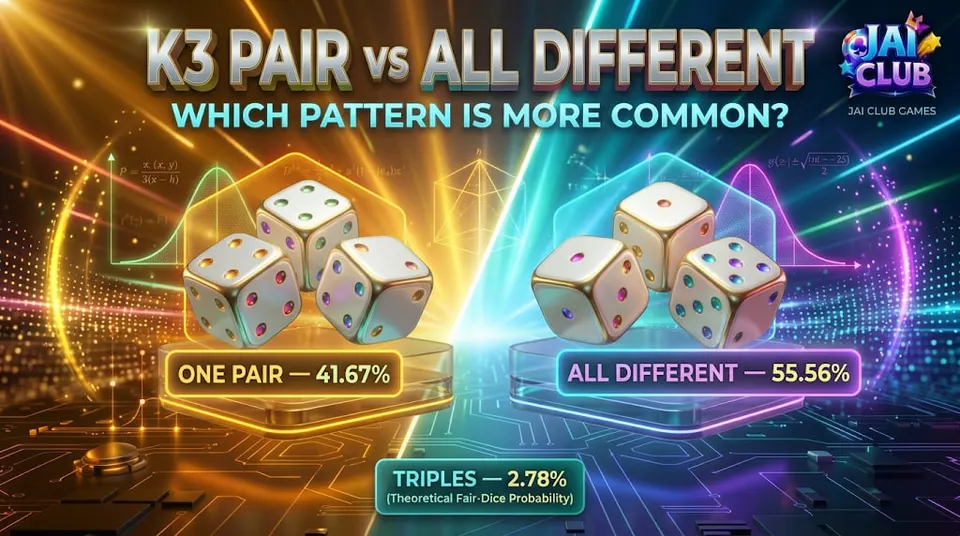
Under the standard fair-dice model, three different dice appear more often than exactly one matching pair.
There are 120 ordered outcomes containing three different values, compared with 90 outcomes containing exactly one pair. The remaining six outcomes are triples, where all three dice display the same number.
Understanding these counts helps explain K3 combination probabilities without relying on historical streaks or unsupported predictions.
This guide uses three independent fair six-sided dice. The calculations describe a mathematical model rather than verified probabilities or settlement conditions from a particular Jai Club provider.
What Does a Matching Pair Mean in K3?
A matching pair occurs when two dice show the same value.
For example, a completed result might contain 2-2-5.
The first two dice match, while the third has a different value.
Another result, 2-5-2, contains the same repeated number, but the matching dice occupy different positions.
In both cases, exactly two dice share one value.
A result of 2-2-2 is different because all three dice match.
That is a triple rather than exactly one pair.
The distinction matters when counting possible outcomes and interpreting pattern descriptions.
A phrase such as matching dice can sometimes include both pairs and triples. However, this article uses exactly one pair to mean two equal values and one different value.
What Does Three Different Dice Mean?
A result contains three different dice when no value is repeated.
For example, 1-3-5 contains three distinct values.
So does 2-4-6.
Even though both examples contain numbers from the same six-sided dice range, their individual combinations differ.
A result such as 1-2-3 is also all-different because every die shows a unique value.
The combined sum does not determine whether the pattern contains matching dice.
For instance, 2-2-5 and 1-3-5 both have a sum of 9, but their patterns differ.
This explains why the individual dice values matter when interpreting K3 results.
A history showing only the combined sum may not reveal whether a pair occurred.
Why K3 Has 216 Possible Ordered Outcomes
Each standard die has six faces.
When three distinguishable dice are used, the total number of ordered combinations is:
6 × 6 × 6 = 216.
The first die can show any of six values.
The second die can independently show any of six values.
The third die has the same six possibilities.
Under the independent fair-dice model, each of the 216 ordered outcomes is equally likely.
However, the broader pattern categories contain different numbers of outcomes.
Some outcomes contain exactly one pair.
Others contain three different values.
The remaining results contain three identical values.
Counting these groups accurately explains their theoretical probabilities.
How Many K3 Results Contain Exactly One Pair?
To calculate the number of results containing exactly two matching dice, we begin by choosing the repeated value.
There are six possibilities because the matching value can be any number from 1 to 6.
Next, choose the value of the remaining die.
It must differ from the repeated value, leaving five possibilities.
Finally, determine where the single different die appears.
It can occupy the first, second or third position.
Therefore, the number of ordered results containing exactly one pair is:
6 × 5 × 3 = 90.
This calculation excludes triples because the remaining die must have a different value.
Under the stated model, there are exactly 90 qualifying ordered outcomes.
What Is the Probability of Exactly One Pair?
The probability is calculated by dividing the number of qualifying outcomes by all possible outcomes.
There are 90 results containing exactly one matching pair.
There are 216 possible ordered results overall.
Therefore:
90 ÷ 216 = approximately 0.4167.
Expressed as a percentage, this is approximately 41.67%.
This is a substantial proportion of possible K3 outcomes.
However, it does not mean that a matching pair must appear in exactly 42 out of every 100 consecutive rounds.
Actual observed frequencies can vary, particularly over short samples.
The probability describes the underlying fair-dice model rather than a fixed schedule for individual results.
How Many Results Have Three Different Values?
Now consider the all-different category.
The first die can show any of six values.
The second die must differ from the first, leaving five possible values.
The third die must differ from both earlier values, leaving four possibilities.
Therefore, the number of ordered all-different outcomes is:
6 × 5 × 4 = 120.
This is greater than the 90 outcomes containing exactly one pair.
The result might seem surprising because matching dice attract attention on the screen.
However, there are many ways for all three dice to show different values.
The mathematical count determines the probability, not the visual familiarity of a particular pattern.
Probability of Three Different Dice
With 120 qualifying results out of 216 possible outcomes, the probability is:
120 ÷ 216 = approximately 0.5556.
Expressed as a percentage, this is approximately 55.56%.
Under the model, an all-different result is therefore more likely than a result containing exactly one pair.
The difference is approximately 13.89 percentage points.
This does not mean the all-different category is guaranteed to occur in the next round.
It means the category occupies a larger proportion of the theoretical outcome space.
A result containing matching values remains perfectly possible.
What About K3 Triples?
A triple occurs when all three dice display the same value.
The six possible triples are 111, 222, 333, 444, 555 and 666.
Each represents one exact ordered outcome.
Therefore, the entire triple category contains six outcomes out of 216.
Its theoretical probability is:
6 ÷ 216 = approximately 2.78%.
Triples are considerably less common than either exactly-one-pair results or all-different results.
However, they are still possible in any independent round.
The fact that a triple is unusual does not establish that it cannot occur twice in succession.
Do All Three Categories Cover Every K3 Result?
Yes, for three ordinary dice, every completed result belongs to exactly one of the three pattern categories.
The result either contains three different values, exactly one pair, or three equal values.
There is no fourth possibility.
The counts also confirm this.
There are 120 all-different outcomes, 90 exactly-one-pair outcomes and six triples.
Adding them gives:
120 + 90 + 6 = 216.
That is the complete number of ordered outcomes.
The corresponding probabilities add to 100%.
This provides a useful way to verify that the counting method has not omitted or duplicated any result category.
Does At Least Two Matching Dice Include Triples?
Yes, and this is an important distinction.
The phrase at least two matching dice includes any result where two or more dice have the same value.
That means it includes both exactly-one-pair outcomes and triples.
The number of qualifying outcomes is therefore:
90 + 6 = 96.
The probability is:
96 ÷ 216 = approximately 44.44%.
This is different from the 41.67% probability of exactly one pair.
A comparison involving matching dice must define whether triples are included.
Otherwise, two articles can appear to disagree while actually discussing different events.
Why the Position of the Single Die Matters
Consider the values 4, 4 and 2.
These values can appear in three distinct orders:
4-4-2, 4-2-4 and 2-4-4.
All three belong to the exactly-one-pair category.
They also have the same combined sum of 10.
However, the ordered outcomes are not identical.
The distinct positions explain why each choice of repeated value and different value contributes three ordered outcomes.
This is a common idea in probability calculations involving distinguishable dice.
When a game records each die separately, the position can form part of the result information.
However, the actual settlement rules determine whether a particular game distinguishes between those positions.
Why All-Different Dice Have More Arrangements
Consider three different values such as 1, 3 and 5.
These values can be arranged in six different orders.
That is because the first position can contain any of the three values, the second can contain either of the remaining two, and the third contains the last value.
The count is:
3 × 2 × 1 = 6.
By contrast, the values 4, 4 and 2 produce only three distinct orders because the two fours are identical.
This explains why all-different value groups contribute more ordered outcomes than pair groups.
It is one of the main reasons the all-different category is larger.
Can a Pair and an All-Different Result Have the Same Sum?
Yes.
Consider the result 2-2-5.
Its combined sum is 9.
Now consider 1-3-5.
That also produces a sum of 9.
The first result contains a pair.
The second contains three distinct values.
Therefore, a sum of 9 does not uniquely determine the pattern.
The same principle applies to many other K3 sums.
A result history that records individual dice provides more information than one displaying only their total.
The distinction matters when discussing K3 number frequency, matching patterns and sum categories.
Why K3 Pairs Are Different From Triples
Pairs and triples are visually related because both contain repeated values.
However, their mathematical outcome counts are different.
A pair requires one repeated value and a separate different value.
A triple requires all three values to match.
There are 90 exactly-one-pair outcomes and six triples.
Therefore, exactly-one-pair outcomes are fifteen times as numerous as triples.
This ratio follows from the fair-dice combination counts.
It is not a prediction about the next round.
A rare triple can still appear at any time.
How Does Pattern Probability Relate to Sum Probability?
Pattern categories and sum categories are different ways of grouping outcomes.
The pair category includes results with many possible totals.
The all-different category also includes a range of totals.
A particular sum, such as 10, can be produced by outcomes belonging to more than one pattern category.
Therefore, the probability of exactly one pair cannot be calculated merely by looking at how often Sum 10 appears.
The correct approach is to count the outcomes satisfying the relevant condition.
This distinction prevents a common mistake: treating a general K3 sum chart as though it also provides complete information about matching dice.
The same result can belong to one pattern category and one sum category simultaneously.
Why Visual Streaks Can Be Misleading
Matching dice can attract attention because repeated numbers look unusual.
For example, results such as 3-3-5 and 4-4-2 may appear visually memorable.
However, a short sequence containing several pairs does not establish that the next result must contain three different values.
Under independent fair dice, each round follows the same theoretical distribution.
The probability of exactly one pair remains approximately 41.67%.
The probability of all different values remains approximately 55.56%.
Earlier results do not force the distribution to compensate in the next round.
Observed streaks should therefore be treated as historical events, not guaranteed signals.
Is a Pair a Better Financial Selection?
Mathematical probability and financial return are different questions.
A more common event may have a smaller payout multiplier.
A rarer event may offer a larger multiplier.
However, the attractiveness of either arrangement depends on the actual settlement rules and expected return.
A provider may also apply special conditions to triples or other patterns.
Without verified payout information, it would be misleading to assign a financial advantage to the all-different or pair category.
The calculations in this guide describe event probabilities only.
They do not guarantee profitable outcomes.
Understanding K3 Within Jai Club Games
K3 is one of several number-based formats discussed in the Jai Club gaming ecosystem.
Unlike WinGo, which commonly focuses on one digit, K3 uses three dice.
That creates multiple useful classifications, including sums, triples, pairs and all-different outcomes.
The individual dice values are therefore essential to interpreting the result.
For a broader explanation of number-based game categories, visit the Jai Club Games overview.
Additional guides covering lottery formats and game mechanics can be found in the blog archive.
The current availability and settlement rules of a particular K3 version must be confirmed separately.
Frequently Asked Questions
Which is more common in K3: one pair or three different dice?
Three different dice are more common under the fair-dice model, with a probability of approximately 55.56%, compared with 41.67% for exactly one pair.
How many K3 outcomes contain exactly one pair?
There are 90 ordered outcomes containing exactly two equal dice and one different die.
How many outcomes have all different values?
There are 120 ordered results in which all three dice show distinct values.
What is the probability of a K3 triple?
There are six triples among 216 ordered outcomes, giving a probability of approximately 2.78%.
Does at least one matching pair include triples?
The phrase at least two matching dice includes triples. Its probability is approximately 44.44%.
Can a pair and an all-different result produce the same sum?
Yes. For example, 2-2-5 and 1-3-5 both sum to 9.
Are matching dice more likely after several all-different rounds?
Not under an independent fair-dice model. Previous outcomes do not change the next round's theoretical probability.
Are these official Jai Club K3 probabilities?
No. They follow from a mathematical model using three independent fair six-sided dice. Actual game rules must be verified separately.
Conclusion
K3 matching patterns are easier to understand when the complete outcome space is divided into three categories.
There are 120 all-different results, 90 exactly-one-pair results and six triples among 216 possible ordered outcomes.
This means three different dice are theoretically more common than exactly two matching dice.
However, the individual dice pattern and the combined sum describe different properties of the same result.
The mathematical probability of a pattern also does not establish its financial value under a particular game.
For more information about numerical game formats, explore the Jai Club Game information hub.
Counting combinations explains why certain patterns occur more frequently. It does not predict which pattern will appear next.