Moto Racing Results: What Do 1st, 2nd and 3rd Place Mean?
Understand Jai Club Moto Racing results, including bike numbers, first, second and third positions, finish order, period IDs and how exact-position outcomes differ from number categories.
In this article
- What Is the Jai Club Moto Racing Game?
- What Does First Place Mean?
- What Does Second Place Mean?
- Understanding Third Place
- Bike Number vs Finishing Position
- How Moto Racing Result History Works
- Why the Order of Motorcycles Matters
- How Many Top-Three Orders Are Possible?
- First-Place Probability vs Exact Top-Three Probability
- What If the Same Bikes Finish in a Different Order?
- How Big, Small, Odd and Even Can Apply to Bikes
- Why Moto Racing Is Different From WinGo
- Why Moto Racing Is Not the Same as K3
- Can the Racing Animation Reveal the Result Early?
- Can Moto Racing Results Be Predicted From History?
- Why a Position-Specific Result Matters
- Frequently Asked Questions
- What is the Jai Club Moto Racing game?
- What does first place mean in Moto Racing?
- Is motorcycle number 1 always the first-place winner?
- What does a result of 4–9–7 mean?
- Does the order of the three numbers matter?
- How many top-three orders exist with ten motorcycles?
- Can previous Moto Racing results predict the next winner?
- Are Moto Racing payouts the same as WinGo payouts?
- Conclusion
Moto Racing looks different from familiar number games such as WinGo and K3. Instead of displaying a single digit or three dice, the interface may present numbered motorcycles competing for finishing positions.
When the race ends, the result can contain several numbers. A reader might see 4, 9 and 7 and wonder whether these are winning numbers, bike identities or finishing ranks.
The difference is important because the number assigned to a motorcycle is not the same thing as the position where that motorcycle finishes.
For people researching the Jai Club Moto Racing game, understanding the result format is more useful than simply watching the racing animation. A result needs to be interpreted according to the game's actual ranking and settlement rules.
This guide explores the commonly described ten-bike Moto Racing format, explains the meaning of first, second and third place, and examines how ranking probabilities differ from ordinary single-number games.
The examples are educational. They do not confirm the current number of motorcycles, available selections or payout rules of every service using the Jai Club name.
What Is the Jai Club Moto Racing Game?
Jai Club Moto Racing is a search term associated with a racing-themed, number-based game format.
In commonly described versions, a group of motorcycles is assigned identifying numbers. The game presents their progress through an animated race and records the finishing order when the round ends.
The main result is therefore different from a conventional WinGo digit.
Rather than producing only one number between 0 and 9, a Moto Racing interface may display a ranked sequence identifying which motorcycles finished in particular positions.
Some descriptions of the game refer to ten numbered motorcycles, making positions such as first, second and third especially relevant.
However, the live game rules determine whether a particular implementation uses ten bikes, how ties are handled and which result categories are recognised.
The distinction between motorcycle identity and ranking remains useful across different implementations.
What Does First Place Mean?
First place identifies the motorcycle recorded as finishing ahead of the other participants under the game's rules.
Consider a fictional race involving ten motorcycles numbered from 1 to 10.
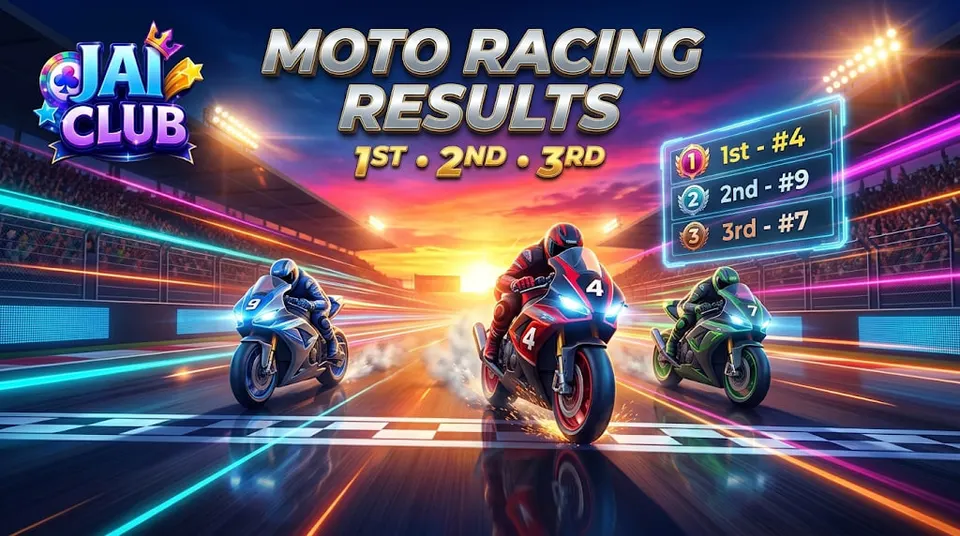
If motorcycle number 4 is declared the winner, the first-place result is 4.
That does not mean the result is the number 1.
The number 1 represents the finishing rank, while 4 identifies the motorcycle occupying that rank.
This is one of the easiest misunderstandings to make when reading a racing result screen.
A display containing the label 1st and the number 4 means that motorcycle 4 finished first.
It does not mean motorcycle 1 was the winner.
The ranking label and the motorcycle identifier answer different questions.
What Does Second Place Mean?
Second place identifies the motorcycle recorded immediately behind the winner.
Imagine motorcycle 9 finishes second after motorcycle 4.
The result for second place is therefore 9.
The number 9 describes the motorcycle, while the word second describes its position.
This distinction becomes important when a game defines position-specific outcomes.
For example, an exact-number outcome associated with first place is different from one associated with second place.
A reader should not assume that identifying the correct motorcycle anywhere in the leading group is equivalent to identifying its exact finishing position.
The settlement of a particular selection depends on the rules published by the provider.
Understanding Third Place
Third place identifies the motorcycle recorded after the first two finishers.
Continuing the example, suppose motorcycle 7 finishes third.
The displayed leading sequence would be:
First place: motorcycle 4.
Second place: motorcycle 9.
Third place: motorcycle 7.
This may be represented as 4–9–7.
The order matters.
If the sequence instead reads 7–4–9, the same three motorcycles are involved, but they occupy different ranks.
A result displaying 4–9–7 does not mean the three motorcycles finished together or that their order is irrelevant.
It describes a particular ranking.
Bike Number vs Finishing Position
The difference between an identifier and a rank is central to Moto Racing.
A motorcycle number is used to identify a particular racing participant.
Its finishing position describes how that participant ranks within the completed race.
For example, bike number 8 can finish first, second, third or in another position, depending on the outcome.
The bike's identity remains 8 regardless of its finishing rank.
A result history that shows the numbers 8, 2 and 6 may therefore represent the first three finishers rather than three unrelated numerical draws.
However, this interpretation must be checked against the interface's labels.
A number should not be assigned a meaning merely because it appears on a racing screen.
How Moto Racing Result History Works
A completed Moto Racing round may be recorded with a period identifier and the relevant finishing positions.
The period identifier distinguishes one race from another.
For example, a fictional history might show period MR-2051 with a top-three result of 4–9–7.
Another period might show 9–2–5.
These two rows describe separate completed races.
The second result does not replace the first, and the numbers in the period identifier should not automatically be treated as part of the ranking.
A reliable history should make it possible to distinguish the round identifier from the result itself.
The presence of a countdown or animated race does not change that distinction.
Why the Order of Motorcycles Matters
An ordered result contains more information than an unordered group.
Suppose three motorcycles are identified as 2, 5 and 8.
If the game records their precise finishing positions, there are several possible ways those three motorcycles could occupy the top three ranks.
The sequence 2–5–8 differs from 8–5–2.
In the first example, motorcycle 2 finishes first.
In the second, motorcycle 8 finishes first.
The same motorcycles appear, but the winning position changes.
This is why exact-order questions are mathematically different from questions about whether a motorcycle finished anywhere among the leading three.
How Many Top-Three Orders Are Possible?
Consider an idealised model involving ten distinct motorcycles.
Assume every complete finishing order is equally likely and no ties occur.
There are ten possible choices for first place.
After the winner is determined, nine motorcycles remain eligible for second place.
After the first two positions are occupied, eight motorcycles remain for third place.
The number of possible ordered top-three results is:
10 × 9 × 8 = 720.
Under this simplified model, each exact ordered top-three sequence has a probability of 1 in 720, or approximately 0.139%.
For example, the precise sequence 4–9–7 is one of those 720 possibilities.
This is a mathematical model, not a verified probability or payout for any specific Jai Club Moto Racing implementation.
First-Place Probability vs Exact Top-Three Probability
Under the same ideal ten-bike model, a particular motorcycle has a one-in-ten chance of finishing first.
That corresponds to 10%.
However, identifying an exact sequence of the first three motorcycles is a more restrictive event.
Its theoretical probability is one in 720 when every complete ranking is equally likely.
These probabilities differ because they describe different questions.
The first asks only which motorcycle finishes first.
The second asks which motorcycles finish first, second and third in the exact specified order.
The greater complexity of the second question does not automatically mean a real platform offers a particular payout.
Settlement multipliers must be obtained from the actual game rules.
What If the Same Bikes Finish in a Different Order?
Imagine that a completed race produces 4–9–7.
Another race later produces 9–7–4.
Both results contain the same three motorcycle numbers.
However, they are different ordered outcomes.
For an exact top-three ranking, the results would not be interchangeable.
This distinction is similar to the difference between ordered five-digit sequences in a 5D lottery.
A result of 12345 is different from 54321 even when both contain the same digits.
Our article on 5D Lottery 77777 vs 12345 explains why ordered sequences need to be evaluated as distinct outcomes.
Moto Racing applies the same broad mathematical idea to rankings rather than digit positions.
How Big, Small, Odd and Even Can Apply to Bikes
Some racing-style number games also describe categories such as Big, Small, Odd and Even.
These categories refer to the motorcycle's identifying number, not necessarily to its finishing rank.
Under a hypothetical ten-bike classification, Odd could include 1, 3, 5, 7 and 9, while Even could include 2, 4, 6, 8 and 10.
Small might cover 1 through 5, while Big covers 6 through 10.
However, these ranges must not be treated as universal Jai Club rules.
A provider may apply category classifications to specific finishing positions or use different settlement conditions.
For example, describing motorcycle 9 as Odd is a mathematical statement.
Whether an Odd selection associated with second place qualifies depends on the actual game rules.
Why Moto Racing Is Different From WinGo
WinGo commonly produces one numerical outcome between 0 and 9.
That digit may then be classified as Big, Small, Odd or Even.
Moto Racing instead uses participant identifiers and finishing positions.
A result such as 4–9–7 contains a ranking relationship.
It cannot be interpreted as three consecutive WinGo outcomes.
Likewise, a WinGo chart does not automatically provide useful information about Moto Racing rankings.
The two formats may both display numbers and countdowns, but their result structures differ.
For a detailed explanation of WinGo classifications, read WinGo Big Small vs Odd Even.
The important lesson is that similar numerical labels do not mean identical game mechanics.
Why Moto Racing Is Not the Same as K3
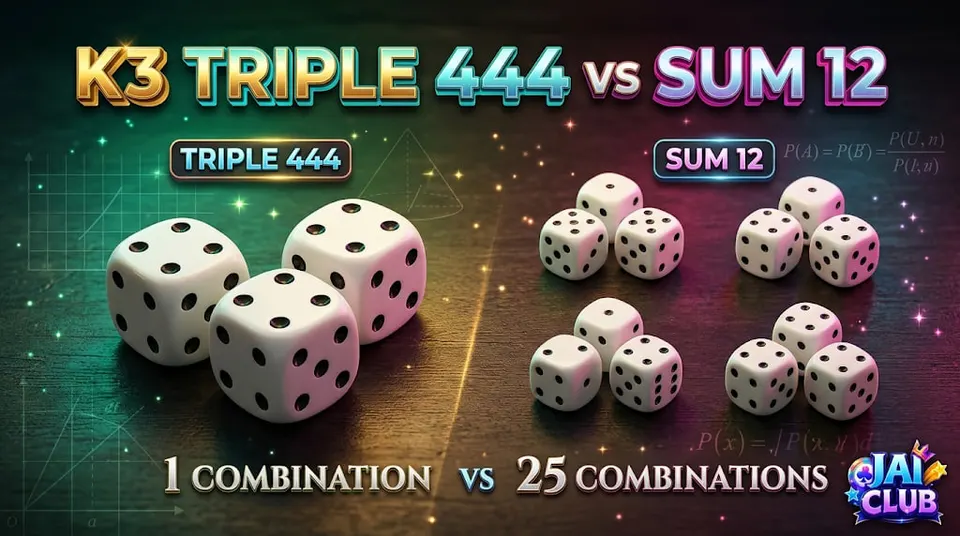
K3 commonly involves three dice whose values are added to produce a total.
For example, 4 + 4 + 4 produces a sum of 12.
Moto Racing is different because a sequence of motorcycle numbers normally describes positions rather than values being added.
Suppose the top three motorcycles are 4, 9 and 7.
Adding their identifiers gives 20, but that total does not automatically represent a recognised Moto Racing result.
The game's actual rules determine whether any sum-related category exists.
A ranking cannot be treated as a dice total merely because both formats display several numbers.
This distinction helps prevent the rules of one game being incorrectly applied to another.
Can the Racing Animation Reveal the Result Early?
An animated race visually represents movement and finishing positions.
However, it does not automatically reveal how the software selected the outcome.
Some software games determine results before displaying the corresponding animation.
Others may use different technical mechanisms.
Without reliable documentation, the animation should not be treated as a complete explanation of result generation.
For example, a motorcycle appearing to lead early in an animation does not establish that it must finish first.
The completed result record is more relevant than a temporary visual position.
A video of a previous race also cannot establish the finishing order of a future independently generated round.
Can Moto Racing Results Be Predicted From History?
A history chart can describe previous finishing orders.
It may show how often certain motorcycle numbers occupied particular positions within the recorded sample.
However, descriptive statistics are not automatically predictive.
If a game uses independent uniformly generated rankings, a motorcycle appearing first several times does not change its theoretical probability in the next round.
Likewise, a motorcycle that has not finished first recently is not mathematically due to win.
A short history may contain streaks that look meaningful even when they are ordinary random variation.
Any claim of reliable prediction would require evidence about the game's actual outcome-generation mechanism.
A sequence of screenshots alone is not sufficient.
Why a Position-Specific Result Matters
A result history should distinguish the exact position being discussed.
For instance, motorcycle number 6 appearing in third place is not the same event as motorcycle 6 finishing first.
A guide discussing Moto Racing first, second and third positions should therefore keep the ranking labels attached to each motorcycle number.
This is particularly important when readers compare screenshots of different rounds.
A cropped image showing only three digits may omit the information needed to identify the correct ranking.
A complete result should include the relevant period and position labels.
Without that context, the numbers can easily be misinterpreted.
Frequently Asked Questions
What is the Jai Club Moto Racing game?
It is a racing-themed game format commonly described through numbered motorcycles and recorded finishing positions. Exact rules depend on the provider.
What does first place mean in Moto Racing?
First place identifies the motorcycle recorded as finishing ahead of the others.
Is motorcycle number 1 always the first-place winner?
No. Motorcycle number 1 is an identifier and can occupy different finishing positions.
What does a result of 4–9–7 mean?
In a top-three ranking format, it can indicate motorcycle 4 first, motorcycle 9 second and motorcycle 7 third.
Does the order of the three numbers matter?
Yes, when the game records or evaluates exact finishing positions.
How many top-three orders exist with ten motorcycles?
There are 720 possible ordered top-three sequences when all ten motorcycles are distinct and ties are excluded.
Can previous Moto Racing results predict the next winner?
Previous results alone do not establish a reliable prediction of future rankings.
Are Moto Racing payouts the same as WinGo payouts?
Not necessarily. Their result structures differ, and actual settlement rules are game-specific.
Conclusion
Moto Racing results become easier to understand when motorcycle numbers are separated from their finishing positions.
In a commonly described ranking format, first, second and third place identify where motorcycles finish. The numbers displayed beside those positions identify the motorcycles themselves.
A result such as 4–9–7 is therefore an ordered ranking, not merely a collection of three unrelated digits.
Understanding the difference between exact positions, number categories and period identifiers is essential for interpreting racing histories accurately.
For wider information about WinGo, K3, 5D and other game formats, explore the Jai Club Games overview.
The completed ranking tells you how one race ended. It does not establish how the next race will finish.