Beyond WinGo: How Jai Club Games Use Dice, Reels, Cards and Multipliers
Jai Club games are not all based on WinGo or colour prediction. Explore the differences between dice games, slot reels, card-based formats, crash multipliers, number games and arcade mechanics.
In this article
- Beyond WinGo: Different Games, Different Ways of Producing Results
- Why WinGo Is Only One Part of the Picture
- How WinGo Uses a Single Numerical Outcome
- K3 Introduces a Completely Different Mathematical Structure
- Why Matching Dice Matter in K3
- How 5D Changes the Meaning of Numbers Again
- Slot Games Replace Numerical Draws With Symbol Arrangements
- Why Slot Reels Can Be Misleading
- Wild and Scatter Symbols Introduce Special Rules
- Card Games Use Relationships Between Several Cards
- Why Card Games Cannot Be Compared Directly With WinGo
- Crash Games Make Multipliers the Main Focus
- Aviator and Chicken Road Show Why Multipliers Are Not Universal
- Plinko Uses a Board Instead of Reels or Cards
- How Game Timing Changes Across Different Formats
- Why Similar Numbers Do Not Mean Similar Probabilities
- What Makes a Game's Result History Useful?
- Why Game Providers and Versions Matter
- Why Understanding Mechanics Matters More Than Appearance
- Frequently Asked Questions
- Are Jai Club Games only about WinGo?
- What is the main difference between WinGo and K3?
- How does 5D differ from WinGo?
- Why do slot games use symbols instead of number results?
- Are Aviator and Chicken Road the same game?
- Do card games follow the same rules as number games?
- Is Plinko considered a slot game?
- Do games showing the same multiplier have equal probabilities?
- Can previous results predict future game outcomes?
- Conclusion
Beyond WinGo: Different Games, Different Ways of Producing Results
When people search for Jai Club Games, WinGo is often one of the first game formats they encounter. Its combination of numbers, colours and short countdown periods makes it easy to recognise, particularly among readers familiar with colour trading.
However, WinGo represents only one type of gaming mechanism. Other games can use dice combinations, five-digit sequences, spinning reels, playing cards, crash multipliers or ball-drop systems.
Although these games may appear within the same gaming catalogue, their underlying mechanics can be very different.
A WinGo result of 5, a K3 dice total of 5 and a 5× slot multiplier do not represent the same event, even though they contain the same number.
This distinction is important because game interfaces frequently use similar numerical values to describe completely different things.
Understanding the underlying mechanics helps readers interpret results more accurately, recognise differences between game categories and avoid applying rules from one format to another.
This article explores the major game systems commonly discussed in connection with Jai Club Games. The descriptions explain general game formats rather than guaranteeing that every title is currently available through a particular provider.
Why WinGo Is Only One Part of the Picture
WinGo is commonly described as a timed number game in which each completed period produces a digit between 0 and 9.
That number may be assigned to categories such as Big, Small, Odd, Even or particular colour associations.
For example, the number 7 belongs to Big and Odd under a commonly used classification system.
The result is relatively straightforward because one digit forms the main numerical outcome.
However, this structure cannot explain every other game format.
A slot game generally evaluates symbols arranged on reels. K3 involves three dice and their combined total. A crash game uses a multiplier that changes during an active round, while a card-based game may depend on the ranks or combinations of multiple cards.
These differences are more significant than the visual themes of the games.
Two games can look completely different while using related mathematical principles. Conversely, two games can display similar numbers while following entirely different result structures.
How WinGo Uses a Single Numerical Outcome
One of WinGo's defining characteristics is its use of a single digit.
In a commonly described format, the possible numbers range from 0 through 9.
The digits can then be divided into numerical groups. Numbers from 0 to 4 are classified as Small, while numbers from 5 to 9 are classified as Big.
Odd and Even provide another way to describe the same digits.
A result of 8, for example, is Big because it belongs to the upper half of the range. It is also Even because it is divisible by two.
Some versions additionally associate numerical results with Red, Green or Violet.
These labels represent different descriptions of an underlying outcome. They should not be confused with separate results generated during the same round.
Our article on WinGo Big Small vs Odd Even explains these numerical categories and how they relate to result interpretation.
The central idea is that WinGo commonly begins with one digit and applies several classifications to it.
K3 Introduces a Completely Different Mathematical Structure
K3 moves beyond a single digit by using three dice.
Each standard six-sided die can produce a number between 1 and 6. When the three values are added together, the total falls between 3 and 18.
Consider a result showing 2, 4 and 6.
The combined sum is 12.
Now consider another result showing 3, 4 and 5. This combination also produces 12, even though none of the three dice arrangements is identical to the first.
This demonstrates an important feature of dice games. Several different combinations can produce the same total.
The result may therefore be described through its individual dice values, its combined sum and any applicable pattern classifications.
Under a mathematical model using three independent fair six-sided dice, there are 216 possible ordered combinations.
The probability of a particular sum depends on how many combinations produce it.
For example, a total of 3 can occur only through 1-1-1, while a total of 10 can be formed through 27 ordered combinations.
This creates a different theoretical probability distribution from an ideal game generating one uniformly distributed digit between 0 and 9.
Why Matching Dice Matter in K3
K3 also contains patterns that cannot be described through a sum alone.
A result showing 4-4-4 is known as a triple because all three dice display the same value.
Its combined total is 12.
However, a result showing 3-4-5 also has a total of 12 without being a triple.
The same sum can therefore represent different underlying combinations.
This distinction matters because a game may define special categories for triples or other matching patterns.
The mathematical classification should also be separated from actual settlement rules. A particular provider may apply special conditions to certain combinations.
For readers interested in this difference, K3 Triple 444 vs Sum 12 explains why an exact dice combination and a broader sum category have different theoretical probabilities.
K3 demonstrates how using several numerical components creates a more complex result system than a single-digit game.
How 5D Changes the Meaning of Numbers Again
A 5D-style lottery introduces another type of numerical structure.
Instead of three dice, the result commonly contains five positions, which may be labelled A, B, C, D and E.
Imagine a completed result of 48163.
The first position contains 4, the second contains 8, the third contains 1, the fourth contains 6 and the fifth contains 3.
Each digit forms part of an ordered sequence.
This differs from K3 because the result is not simply the sum of three dice. It also differs from WinGo because the completed outcome contains several positions rather than a single digit.
Position becomes especially important when comparing sequences.
For example, 12345 and 54321 contain the same five digits, but their order is different.
In a position-based format, they represent different ordered outcomes.
This distinction also matters when repeated digits appear.
A result such as 77777 may look much more unusual than 12345. However, under an ideal model where five digits are generated independently and uniformly, both exact sequences have the same probability of 1 in 100,000.
Our article on 5D Lottery 77777 vs 12345 explores that mathematical curiosity in more detail.
The important lesson is that a visually distinctive result is not necessarily an individually less likely result.
Slot Games Replace Numerical Draws With Symbol Arrangements
Slot games introduce a different way of presenting outcomes.
Instead of showing one digit or several dice, a conventional slot game uses reels containing symbols.
The result is evaluated according to the game's paytable and matching rules.
A slot might display gemstones, crowns, stars, coins or other illustrated symbols.
However, the symbols themselves do not explain the entire mathematical system.
The important details include where the symbols appear, which arrangements qualify and how the game calculates the corresponding payout.
Some slots use traditional paylines, while others use alternative matching systems.
A game with three reels may evaluate results differently from one with five reels.
Even two slots using similar symbols can have completely different paytables.
This is why the visual theme alone cannot establish how a slot game works.
Why Slot Reels Can Be Misleading
Slot reels often animate before revealing the completed result.
During that animation, symbols may appear to move through positions that would form winning combinations.
However, the displayed movement should not automatically be treated as evidence that the game nearly generated a different result.
In software-based games, the underlying result mechanism and the animation used to present that result are distinct concepts.
A player may see two matching symbols and a third symbol stopping just outside a qualifying position.
This can create a strong feeling of almost winning.
Nevertheless, a visually close result does not establish that the next spin is more likely to produce the desired combination.
Our article on why slot near-misses feel so close examines how the presentation of almost-winning results can influence human perception.
The difference between visual appearance and the actual paytable is essential for understanding slot games.
Wild and Scatter Symbols Introduce Special Rules
Some slot symbols perform functions beyond ordinary matching combinations.
Wild symbols commonly substitute for certain other symbols, depending on the game.
Scatter symbols may trigger bonus features or provide other game-defined outcomes.
However, their exact roles vary between titles.
A Wild in one slot may behave differently from a Wild in another.
Similarly, the number of Scatters required for a bonus feature is not universal.
This means two games with similar-looking reels may still follow very different mathematical rules.
A particular symbol should be interpreted according to its game's documentation rather than assumptions based on another title.
These special features are one reason slot games cannot be explained using the same number classification applied to WinGo.
Card Games Use Relationships Between Several Cards
Card-based games introduce another family of mechanisms.
Their outcomes can depend on card ranks, suits, hand combinations or comparisons between participants.
The exact rules vary considerably between game types.
In some games, a pair of matching ranks may have particular significance. In others, a sequence of cards or the combined value of a hand may determine the outcome.
Unlike a single-digit number result, a card hand often contains several pieces of information.
A card's rank identifies one characteristic, while its suit identifies another.
When several cards are involved, their relationships may create additional categories.
For example, a pair is not the same as three matching cards, and a sequence is not automatically equivalent to a hand containing unrelated values.
However, these descriptions do not establish one universal card-game ranking system.
Different games define their own qualifying hands and comparison rules.
The availability of particular card titles through a Jai Club-related service must also be verified rather than assumed from the broader gaming market.
Why Card Games Cannot Be Compared Directly With WinGo
WinGo commonly describes one numerical outcome using fixed categories.
Card games often evaluate combinations of multiple objects.
This creates a different type of mathematical question.
In WinGo, readers might ask whether a digit is Big or Small.
In a card game, the relevant question might concern whether a hand meets a particular combination requirement.
Even when both games display numbers, those numbers may represent completely different concepts.
A card rank of 7 is not the same event as a WinGo result of 7.
Likewise, a total calculated from several cards cannot automatically be compared with a K3 dice sum.
The meaning comes from the rules attached to the numerical value.
Crash Games Make Multipliers the Main Focus
Crash games move away from traditional dice, cards and reels by placing a changing multiplier at the centre of the interface.
Aviator-style games commonly display a multiplier increasing during an active round.
An illustrative sequence might move from 1.00× to 1.40×, then to 2.10× and beyond.
The round terminates at a crash point defined by the game's mechanism.
Unlike WinGo, the central result is not simply one digit selected from 0 through 9.
Instead, the completed crash multiplier represents an endpoint within a different mathematical system.
The value 2.50× should therefore not be interpreted as a WinGo result of 2 or 5.
It represents a payout coefficient under the relevant game's rules.
The distinction between a multiplier and a numerical draw is important because the same numbers can appear in both interfaces without describing equivalent events.
Aviator and Chicken Road Show Why Multipliers Are Not Universal
Even within multiplier-based games, the mechanics can differ.
Aviator commonly uses a rising coefficient during an active crash round.
Chicken Road, particularly the original step-based format, organises gameplay around progressing through successive road-crossing stages.
Both games may display a multiplier of 2.00×.
However, the process leading to that value is different.
In Aviator, the coefficient may be reached during the active flight stage.
In Chicken Road, it may represent the result of progressing through several successful stages.
The numbers look identical, but their underlying event structures are not necessarily equivalent.
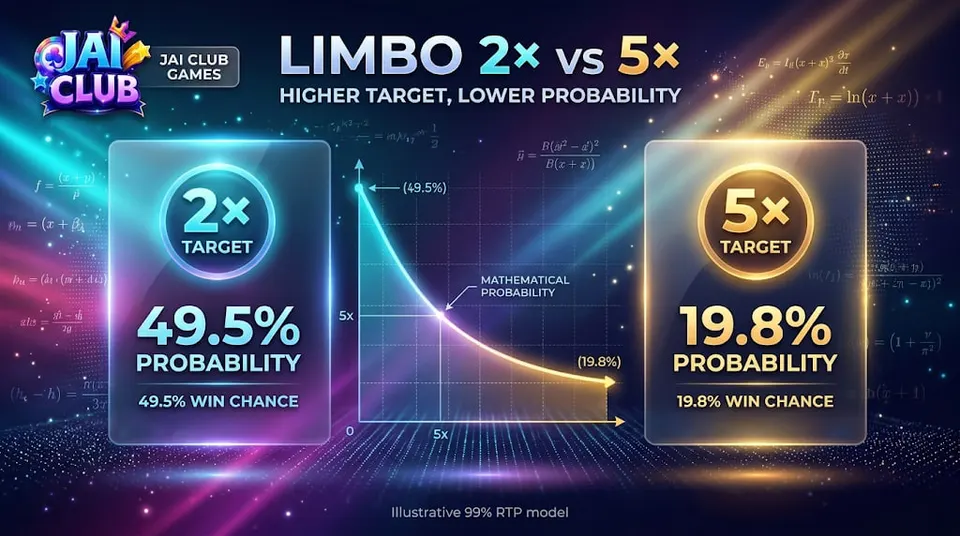
A multiplier alone also does not reveal the probability of reaching a particular outcome.
To understand the comparison, readers can explore Aviator vs Chicken Road: Multiplier Differences.
Plinko Uses a Board Instead of Reels or Cards
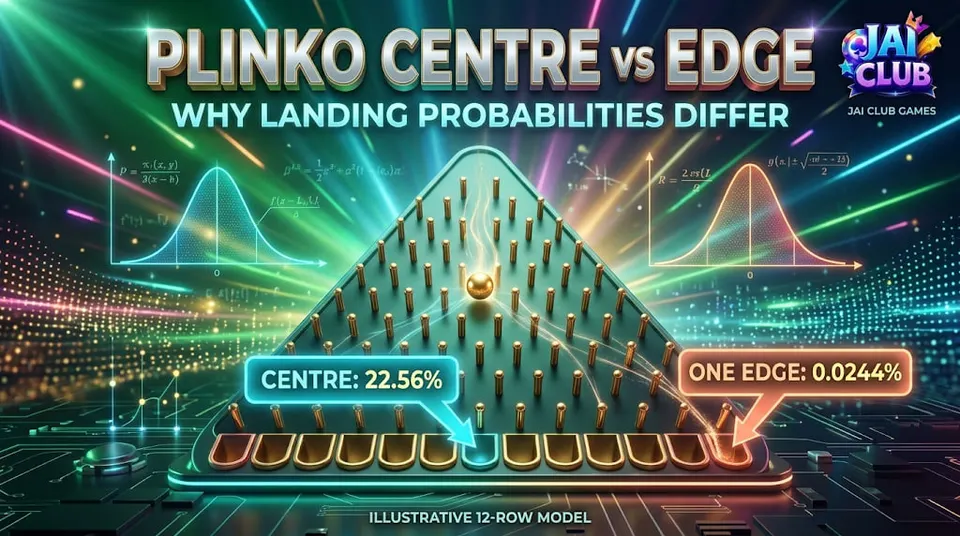
Plinko-style games introduce a visually distinctive mechanism built around a board of pegs and landing positions.
An animated ball moves through the board before reaching a result area.
The available positions may correspond to different multiplier values or other rewards.
This format looks different from conventional slots because there are no spinning reels.
It also differs from card games because the central outcome does not depend on a hand of cards.
However, the animation should not automatically be assumed to follow physical real-world randomness.
Software-based Plinko games can use defined mathematical mechanisms to produce results.
Different versions may also offer different board layouts, risk settings or reward structures.
These settings can affect the range of possible outcomes, but the exact probabilities depend on the particular implementation.
A visually attractive ball-drop animation does not independently reveal how the underlying probabilities are calculated.
How Game Timing Changes Across Different Formats
Time is another useful way to distinguish gaming categories.
WinGo commonly uses fixed countdown periods. K3 and 5D may also organise results around scheduled draws.
Conventional slots generally begin a spin following an authorised action rather than waiting for a shared lottery countdown.
Crash-style games often combine a preparation phase with an active round during which the multiplier changes.
Step-based games may organise progression around individual decisions and animation stages.
Card games and Plinko-style formats can use their own timing systems.
These differences affect how the interfaces present results.
However, timing should not be confused with outcome probability.
A shorter game is not automatically more predictable. A longer countdown does not guarantee a more favourable result.
Our guide to Jai Club Games with Timers vs Instant Play examines how these timing structures differ.
Why Similar Numbers Do Not Mean Similar Probabilities
One of the most interesting features of online games is how frequently identical numbers appear in unrelated contexts.
Consider the number 5.
In WinGo, it may represent a complete numerical result.
In K3, it can represent the sum of three dice.
In 5D, it may be the value of one position within a five-digit sequence.
In slots, a displayed 5× may describe a payout multiplier.
In a crash game, 5.00× may represent a multiplier reached during an active round.
These are different events with different mathematical meanings.
It would therefore be incorrect to assume that the probability of each event is identical.
For example, under an ideal uniform single-digit model, the probability of obtaining the digit 5 is 10%.
For three independent fair six-sided dice, the probability of obtaining a sum of 5 is approximately 2.78%.
The numerical symbol is the same, but the event being measured is different.
Actual game probabilities must be established from the relevant rules and outcome-generation mechanisms.
What Makes a Game's Result History Useful?
Result histories can help readers understand the format of completed outcomes.
A WinGo history may contain numerical results and period identifiers.
A K3 history may display individual dice values and their sum.
A 5D history may show five-position sequences.
A crash history may record completed multipliers, while a slot history may focus on spins and credited payouts.
These records describe events that have already happened.
However, they should not automatically be treated as reliable prediction tools.
A repeated number in WinGo does not establish that a different digit must appear next.
A sequence of low crash multipliers does not guarantee that a high multiplier is due.
Likewise, several slot near-misses do not establish that a bonus will occur shortly.
Historical data is useful for interpreting records, but claims about future outcomes require evidence about the actual underlying process.
Why Game Providers and Versions Matter
Games with similar names or visual themes may use different mathematical rules.
Two slot titles can feature gemstones and golden symbols while having different paylines, bonus conditions and payout distributions.
Two crash games can display rising multipliers while following different event structures.
Even different versions of a named game may contain changes in available features or presentation.
This is why the provider's documentation matters.
A general article can explain the common mechanics of K3, 5D, slots, cards and crash games, but it cannot establish the exact rules of every individual title.
Similarly, a game appearing in a broader online gaming catalogue does not prove that it is currently available through every Jai Club-related service.
Readers should distinguish between general game education and verified information about a particular provider.
Why Understanding Mechanics Matters More Than Appearance
Game interfaces are designed to make information visible and engaging.
A spinning reel, rising plane, rolling die or moving ball provides a visual representation of an event.
However, the animation does not necessarily explain the mathematics behind the result.
Two games may use completely different animations while sharing some broad probability principles.
Others may use similar visual elements while having different outcomes and settlement structures.
The most useful approach is to identify the main result type, understand the relevant rules and distinguish the outcome from the interface used to present it.
That provides a clearer understanding than judging a game solely by its graphics or the size of a displayed multiplier.
Frequently Asked Questions
Are Jai Club Games only about WinGo?
No. Jai Club-related gaming guides discuss several categories, including WinGo, K3, 5D, slots, crash games and other formats.
What is the main difference between WinGo and K3?
WinGo commonly uses a single-digit result from 0 to 9, while K3 uses three dice and their combined total.
How does 5D differ from WinGo?
A 5D result commonly contains five numerical positions, while WinGo generally focuses on one digit.
Why do slot games use symbols instead of number results?
Conventional slots evaluate symbol arrangements through their paytables and matching rules, although they may also display numerical stakes and multipliers.
Are Aviator and Chicken Road the same game?
No. Aviator commonly uses a rising crash multiplier, while Chicken Road uses step-based progression.
Do card games follow the same rules as number games?
No. Card games rely on their own rules involving ranks, suits and combinations.
Is Plinko considered a slot game?
Plinko-style games generally use a peg-and-ball board rather than conventional slot reels, although both can appear in broader online gaming catalogues.
Do games showing the same multiplier have equal probabilities?
Not necessarily. The probability depends on the game's outcome-generation mechanism and settlement conditions.
Can previous results predict future game outcomes?
Previous results alone do not establish reliable predictions without evidence about the underlying mechanism.
Conclusion
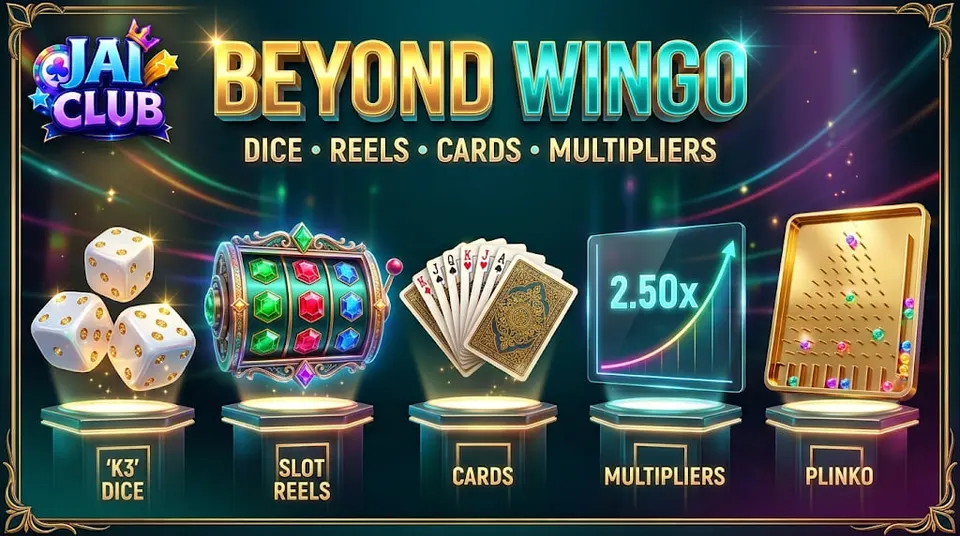
Jai Club Games covers a broad range of gaming concepts that extend beyond the familiar WinGo format.
WinGo commonly uses a single numerical result. K3 introduces three-dice combinations, while 5D uses five-position sequences. Slot games rely on symbol arrangements, card games use title-specific hand rules, and crash games focus on multipliers.
Plinko and other arcade formats introduce further variations in how results are generated and presented.
These differences demonstrate why one universal explanation cannot describe every game.
For an introduction to the broader platform, its gaming categories and related informational resources, explore the Jai Club Games guide.
Understanding how a game produces and displays its results is more important than assuming similar numbers or graphics mean similar rules.